Let’s talk about stigma

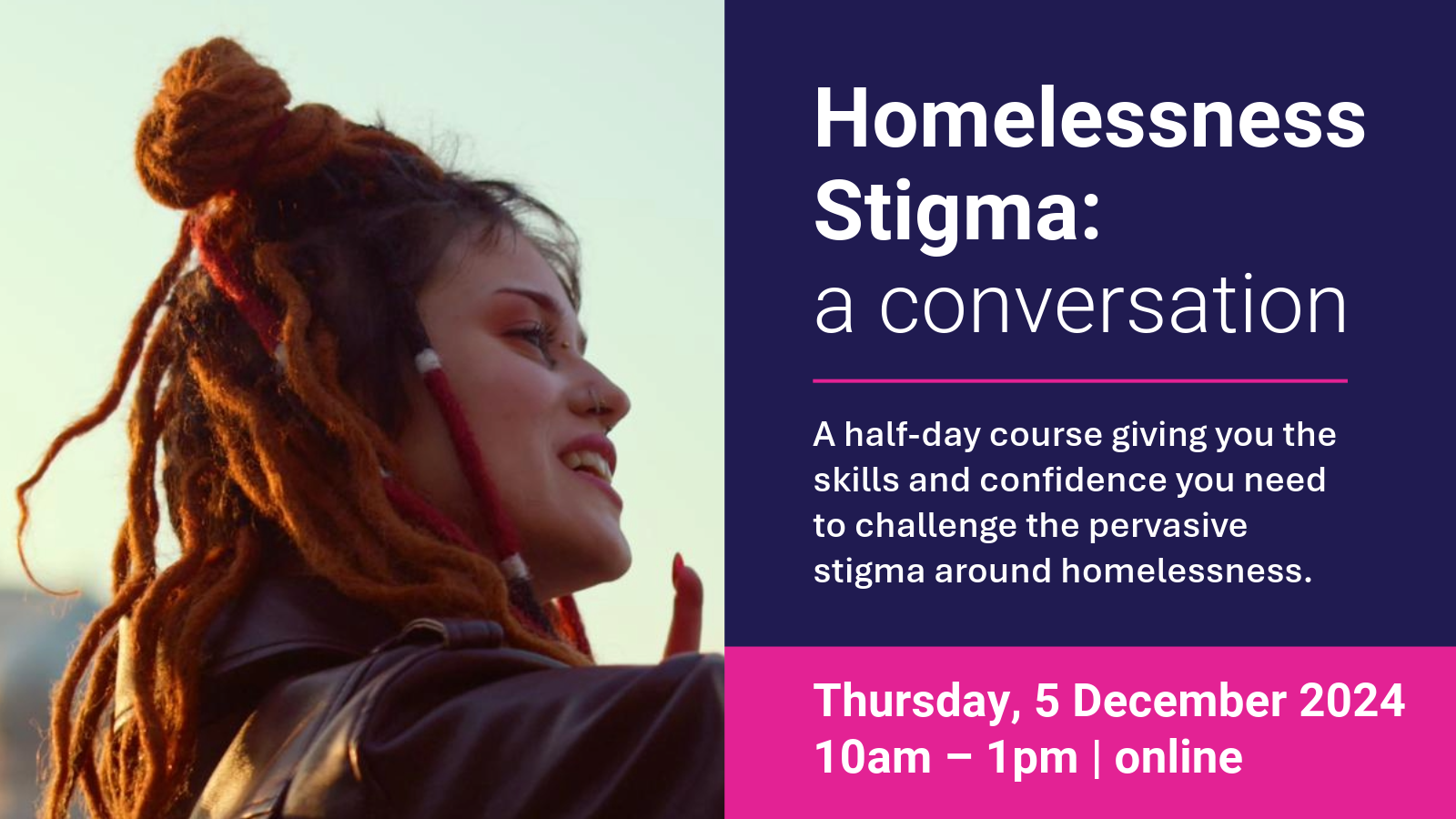
A new Learning Lounge course launching on 5 December explores the drivers and impact of stigma. Homelessness Stigma; a conversation is an interactive, half-day course which will give you the skills and confidence you need to challenge the pervasive stigma around homelessness.

By the end of the session, participants will be able to reflect on the power dynamics in their work, identify stereotypes in representations of homelessness, use positive framing to reduce stigma, and learn about the barriers people accessing services face, including stigma.

In this blog, Homeless Network Scotland Associate David Pentland sets out why we need this course and how it can benefit everyone.


Stigma is pervasive and insidious, and it can be held by anyone regardless of their good intentions.

The judgments we make about people are often subconscious and rarely malicious. But we need to challenge our conditioning and fears, to overcome the bias we hold, making it easier to treat every person we meet or work with equally and fairly.  

To combat the unconscious bias we experience we must confront the issue head-on by conversing and exploring its nature, without any judgment.  

We want to help people understand unconscious bias. It’s really an unconscious reaction to fear, based on vulnerabilities that frighten us. 

It’s important to note that this course is not ‘training’ – that’s why it’s called ‘Stigma: a conversation’. It’s a space to explore in safety and get in touch with how bias works and identify some of the subtle directions it whispers at us from. 

‘Many people will be too ashamed to go into the homelessness system’

Stigma is everywhere and you see it in the media through the use of images of people sleeping rough and beggars to represent homelessness. Only a very small minority of overall homelessness involves rough sleeping. 

The impact these pictures has is that people experiencing homelessness who aren’t sleeping rough may feel they are falling into that stigmatised category. The more that imagery is used, the more stigmatised the majority of people experiencing homelessness feel.  

That can stop people from speaking up and asking for help. And it colours the way family and friends see them, because everyone reacts to imagery. Everyone gets locked into that image even if it’s not necessarily a true representation of where they are in life.  

This can transfer into a feeling of shame. That adds to hidden homelessness, as many people will be too ashamed to go into homeless system. Instead they’ll be staying with friends or sofa surfing.

This conversation also covers the equality aspect. There’s a well-worn saying that ‘everyone is two paychecks away from homelessness’.

That’s not true – the risk is not equal for everyone. In the session we expand on some of the life experiences and factors like a lack of social connections that make people more vulnerable to homelessness.  

The more of those experiences you have – like adverse childhood experiences, being a care leaver, having a background of poverty – the more likely you are to become homeless when you encounter financial difficulty.

When you add in factors like addiction, more avenues of stigma are opening up.

‘Everyone deserves an equal service’

Sometimes in services people cycling through the system experience stigma and end up being excluded from support. Staff can be burned out and can react badly. 

One of my worst experiences was entering a service in Edinburgh to be greeted by a member of staff saying, “Not you again? What is it?” I left and never went back!  That’s the harm stigma can cause. It turns people looking for support away at the door, with untold consequences.  

This course was created by a rough sleeper of 15 years who suffered severe and multiple disadvantage and lived in so much chaos no service would work with him.  All except one person.  

That person – that service – helped him to recalibrate his life. He went on to work as a frontline worker and even spent two years as a policy officer in the Scottish Government.  

We want people to come away from the session realising that everybody deserves an equal service irrespective of where they come from or how they present, and everybody deserves to live without the toxicity of stigma present in their life. 

Stigma is out there and it is killing more people who are homeless than you might think. Come join our conversation – you might help a lost cause get their life back.

Introducing our new Learning Lounge training programme

Hi, hello, fàilte, walcum to our Learning Programme for 2024. I am Laura the new(ish) Learning Lead for Homeless Network Scotland. Some of you may have already met me at our sold-out online training sessions or at commissioned workshops for your organisation or regional Housing Options hub. We have already delivered 10 sessions and trained 150 people since I started in May, wow!

I am excited to share with you our refreshed training programme and some exciting new developments in the pipeline. 

Since I started the role in May, the list of organisations on the Housing Regulator’s watch list has grown longer, and more and more councils have declared a housing emergency. Since we started planning the new programme, the Scottish Government has announced a nationwide Housing Emergency, and the Housing Bill’s proposed prevention duties have been debated in Parliament.  

What does this mean for our sector’s learning and development? Now more than ever, we need to understand the history and policy landscape so we can reflect on how we ended up here.

We need to learn more about well documented good practice and what works preventing homelessness in communities.

And we need to focus on where the system is not working for marginalised people and groups.

It is important that we share our collective knowledge with a wider set of connected services and community groups, beyond traditional housing and homelessness teams. 

Our Learning Lounge modules are designed to equip you and your team with the knowledge, skills, confidence and connections you need to effectively deliver your important work.

Our programme combines what members have asked us to develop, with evidence and research into what is working to end homelessness.


Training for Individuals 

Our open programme has three core modules running across the year, covering an introduction to relevant legislation and policy; what we know works to prevent homelessness; and understanding the impact of inequality in the homelessness context.  

Interactive sessions are held online via Teams and later in the year we will be returning to Glasgow city centre at your request. Each session provides an invaluable opportunity to hear from members across Scotland and learn from each other and our expert trainers.  

Whether you are a case worker, support worker, new volunteer or a board member, our three sessions will give you a good grounding by covering the evidence, good practice principles and challenges arising across the homelessness sector. 

Our current modules include: 

  • A Rough Guide to Homelessness Policy and Legislation 
  • Closer to Home: a place-based approach to preventing homelessness 
  • The Unequal Risk: an equality lens in housing and homelessness 

Registration is now live in the Learning Lounge, and you can book a course today. 


Training for Organisations 

Our in-house programme focuses on building practical skills and helping teams to connect around innovative solutions. We deliver sessions online, in person or in a hybrid setup for organisations and community groups across Scotland.  

We work with homelessness service providers, local authorities and housing associations to design the perfect standalone module or cohesive training package.  

Our ten available modules help you to connect with the complex landscape, learn more about existing legal duties and act in a more person-centered way. 

Navigating the landscape in Scotland  

  • An introduction to policy 
  • Prevention and a place-based approach 

Complying with current frameworks and legal duties 

  • Housing First 
  • The Housing Bill and prevention duties 
  • Equality and equity  
  • Equality impact assessment 

Person-centred approaches 

  • Trauma informed approaches and psychologically informed environments 
  • Stigma and perceptions 
  • Lived experience and co-design 
  • Wellbeing at work 

➡ To find out more or discuss a bespoke module, get in touch with Laura to explore creating in-house training for your team or organisation.


What’s new and coming soon? 

There are lots of new developments across the learning programme this year. Here is a quick summary of what is new: 

  • A training module about challenging stigma and perceptions of homelessness has been collaboratively designed by Homeless Network Scotland Associate David Pentland and will launch on 5 December. 
  • An eLearning platform will be launching soon with courses and shorter on-demand webinars 
  • Specialist modules about health and homelessness have been requested and are being scoped 
  • The return of in-person training for all of you who love learning with a cup of tea or coffee instead of on Teams 
  • Tailored sessions designed for line managers, senior managers and board members are being developed 

If you have a training idea or module you would like to see us deliver in future, please reach out and get in touch with Laura. 

Training Funding available 

Don’t forget, if you don’t have access to an organisational training budget, we do sponsor some free open programme places and St. Martin in the Fields Frontline Network offer a training fund of £500 for individual training and £1500 for group training. Find out more about their eligibility criteria and how to apply for funding. 

We hope to see you soon, or dreckly as the Cornish would say (yes there will be more Cornish language sharing in the training slides for all the polyglots).     

Housing First in focus: Glasgow

From 31 tenancies in 2018 to 318 total tenancies today, Housing First has scaled up in Glasgow, providing homes with flexible support for people whose homelessness is complex and often tied up with issues including mental health and addiction.

The city’s Health and Social Care Partnership (HSCP) works successfully with Housing Associations to provide Housing First homes, with a current target of 600 tenancies.

A sample of 20 tenants shows that prior to their tenancies they made a combined 220 homelessness applications, some dating as far back as 1994 – Housing First clearly works to keep people facing overlapping disadvantage in tenancies.

Eleanor Lee, Principal Officer for Housing First at Glasgow City Health and Social Care Partnership, says the city has learned on the job and refined its processes over the last six years in the face of unprecedented pressures. Here, she sets out how the system operates to ensure people’s wellbeing needs are met.


My team consists of a team leader, senior addiction practitioner, eight assessment officers and a resource worker supporting governance.

The first step is a referral to Housing First – anyone can refer you and you can self-refer. A crucial new addition at this stage is an in-depth pre-screening of candidates, looking at their historical data on our systems.

The idea is to assess risk, look at how systems have responded to a person’s needs and trauma, what needs to happen this time to keep a person in a tenancy. A care manager has input from the start of the process. The assessment is also available across the HSPC systems, meaning applicants don’t have to repeat their story again and again.

We then link up with a Registered Social Landlord who has accepted the tenant to discuss matching their needs to a tenancy and raising any potential issues.

Successful applicants sometimes have to wait for upgrades to a void and it can be a challenge keeping them stable in temporary accommodation while they wait. But some of our tenancies have been out of this world. Low-level, great condition houses. It’s not all perfect but there’s really been an effort here to make the best offer.

A care plan is then put in place. When someone is moving into a new type of tenancy, wraparound support and building a relationship with a support worker is critical.

In Glasgow we recognise that a good relationship with a Housing Officer is important too, and they will meet the tenant before the tenancy. The tenant is more likely to flag problems if they have a rapport – say the water’s off, they might not tell their care manager or support worker.

Landlords often add in a bit extra – a starter pack, or fire-resistant bedding if a fire risk has been identified – instead of refusing housing which would have happened in the past. The aim is to prevent issues arising in the first place.

Once the tenant has moved in, six and 12-week reviews are carried out with them, in the property, to ensure they’re safe and well before we sign-off on the tenancy. They may be vulnerable to exploitation or self-harm, like cuckooing and hoarding. There is a part missing though. When your life has been chaos for 20 years you might not know how to run your home, how to keep it clean and tidy. People should have the opportunity to learn these skills before their tenancy starts.

During the tenancy, a cycle of care managers will be on board to get responses within the HSPC to things that aren’t going right – this is where a whole systems approach comes in.

There is an issue around mental health services; our shared understanding of the issues is unclear. Sometimes we’ll see a tenant struggling mentally even after a community practice nurse has said they’re fine. We’ll try to look back in whether through the adult support protection route, the care manager, a service review – whatever needs to be done.

Quite often when we start assessment people have burnt their boats with their family, and after coming into Housing First they re-establish connections.

One tenant was in the Bellgrove Hotel hostel in Glasgow for 14 years. His marriage broke down, he was separated from his wife and kids, he lost his job, was drinking heavily and had anger management issues. He now needs no support and has re-engaged with his family. He told us: “I’m not angry at life now – I’m happy with life”. Others have moved on in recovery, they’re going to university, taking courses.

The final stage is the overview. We have a weekly live caseload with updates on cases from the support organisations, and a fortnightly case management meeting to highlight concerns about tenants.

We work with the wider homelessness system in Glasgow, liaise with RSLs and provide six-monthly Scottish Government monitoring report with qualitative information about tenants, looking at their journeys rather than seeing people as numbers. Reporting includes within the GCCHSPC and to the Integrated Joint Board. There is a huge amount of governance and reporting but you need to understand how things are going.

During Covid there were no lets and we’ve not properly recovered. There’s big pressure on homelessness from leave to remain cases, from indigenous presentations, and a downturn in availability of housing. Referrals are more than double the 318 tenancies.

But looking at the statistics, of the 61 people in tenancies in 2021/22, 45 are still there, which is remarkable. You can see how the system of assessment is improving, support is improving and having an impact. It’s amazing to see.

Guest blog: supporting survivors of childhood sexual abuse to avoid repeat homelessness

Young women who have been subjected to childhood sexual abuse are more likely to end up homeless, and homeless women are more likely to suffer sexual abuse. So breaking that cycle is vital when survivors start a tenancy.

Kirsty Roebuck, formerly a Tenancy Sustainment for Survivors worker at SAY Women, sets out the issues survivors can face when accessing services and the approaches housing staff can adopt to offer the best support.

You’re waiting on a bus when a man approaches and asks for a lighter. You give him it, thank him for its return and try to avoid small talk. He asks if you’d fancy coming over for a cuppa and says you can even stay the night. Hard pass, right?

Imagine a different scenario. You’re sleeping rough. You’re cold, tired, haven’t eaten and all you want is a warm bed. A man approaches, asks for a lighter, you get chatting. He’s got a house round the corner, there’s a cuppa and a couch with your name on it if you want. Not such an easy decision…

But it’s a decision women who are homeless face regularly – weighing up their physical and mental needs while calculating the risks.

Childhood sexual abuse increases the risk of homelessness for women, whether that involves sofa surfing, sleeping rough or temporary accommodation. It can lead to poorer mental and physical health, causing difficulties holding down a job or sustaining friendships. Drugs or alcohol offer an escape but survivors risk becoming stuck in addiction, turning to prostitution to support themselves.

Childhood sexual abuse also distorts perceptions of healthy relationships. Is he that bad if he’s making sure you’ve got a roof over your head and the substances you need?

That’s kindness, right? Or is he keeping you dependent on drugs and his help to get what he wants? Most of us will have experienced break-ups but for survivors that can mean sleeping rough and facing withdrawal.

To many survivors, a housing worker can represent an authority figure – someone who can make them homeless. Survivors often cope with this power imbalance by refusing to engage.

This is why it’s important for housing staff to keep survivors’ needs at the front of their mind. Dealing with a small problem can prevent it escalating into a big problem.

So what can people in housing and homelessness services do to support survivors?

Ask the question

Asking if the young woman is a survivor can highlight areas that may require extra support. They might not be ready to disclose, but asking shows you’re willing to have those difficult conversations and are a safe person to talk to. If the person opens up, it’s fine to say you’re not qualified to provide psychological support, but you’ll help them find the right service who can.

Ensure support is readily available

Survivors of childhood sexual abuse can experience feelings of shame and low self-worth, often adding a sense of failure by asking for help. This can be avoided by offering help before it is asked for and one way to do this is by offering a planned time that allows the survivor to have a friend present, to avoid being alone with a male worker.

An alternative would be to offer to have a female worker present if maintenance work is being carried out by a male as standard. This suggests it’s not uncommon to find it difficult being alone with an unknown male maintenance worker, and structures are in place to help.

Identify vulnerabilities early

Survivors of childhood sexual abuse often seek connection, resulting in flexible boundaries and risking exploitation as others identify their tenancy as a ‘party flat’. In order for housing staff to distinguish between ‘problem tenants’ and those at risk of exploitation, identifying a survivor early in the housing process is crucial.

Give people power and control

Survivors of childhood sexual abuse who have experienced total loss of control and betrayal from those in power such as family or other adults can find the power that housing staff hold quite intimidating.

Encourage the survivor to take control by giving them options for how they want to communicate. Some people prefer face-to-face so they can read body language, others like texting so they can take their time to formulate a reply. Additionally, arranging visits at convenient times is an effective way for the survivor to take control of the tenancy, reinforcing that she controls when others are allowed access to her property.

In conclusion

Sexual violence can permeate every aspect of a person’s life, even after years of recovery and healing. Shelter is an essential and the ability to sustain this is crucial. Through recognising the needs of survivors and being able to support them in their tenancy, this breaks the cycle of homelessness and creates a brighter future for survivors.

Kirsty Roebuck

Bethany Christian Trust/Simon Community Scotland

GHIFT blog: Why I’m All in for Glasgow

All in for Glasgow is facilitated by Homeless Network Scotland to co-design a blueprint for services people in the city affected by homelessness need during the cost of living crisis and beyond.

Commissioners, service providers and people with lived experience are working together in a series of design sessions to create a service model focused on people’s needs and with fairness and equality built into it from the start. HNS Associate and Glasgow Homelessness Involvement and Feedback Team (GHIFT) member Jeremy talks about what it means to him to be involved in the programme, which was launched earlier this year.

Being asked to write this blog about All in for Glasgow made me reflect on why I got involved in this work. It’s been more than five years and I’ve seen so many changes in myself and in my role at Homeless Network Scotland.

Through my own experience of becoming homeless, I understand the many barriers people face when accessing services.

I just felt this passion and urge to get involved. I wanted to have a voice again and to hear the voices of others who are out there struggling. Basically, I’m Glaswegian and I care about the people in this city.

I started out volunteering for the first three years as a member of the Glasgow Homelessness Involvement and Feedback Team (GHIFT), which I loved as I was able to engage with people across the city who where accessing different services and give them an opportunity to have their voice heard.

A big shift happened for me when my role changed and I became an Associate of HNS, which meant I now had a worker role and was paid for any hours I worked.

Becoming a worker made a big difference to me personally, and I could see the difference it made to the relationship I had with my family, which has gone from strength to strength.

Getting this opportunity to be involved in All in for Glasgow has come at a good time for me. I feel that I’m in a good place – that really matters when you’re involved in this type of work, as you need to bring good energy and new ideas to make any kind of positive change.

Looking back on my own experience of homelessness, I’m now aware there are a lot of myths out there among the public regarding someone who is or has been homeless. This is something that I’m always challenging, and being involved with HNS gives me the space to do this.

Being involved in designing new services is really interesting, challenging and fun – sometimes that is forgotten. All of this work gives me focus and the challenge I need right now.

Working with other people who have experienced homelessness is a great learning opportunity, as people bring so many skills to the table.

Being part of All in for Glasgow will give me the chance to make sure I hold all the services to account and to reach the standard I believe people using the service deserve. People need to be listened to and it should be solutions focused.

Working with this group of people makes me feel like the future is bright for me and the people of Glasgow.