What does the national housing emergency look like on the ground? How is it affecting people at risk of homelessness and the staff trying to support them? What’s getting in the way of improving things and what’s going well despite the pressures?
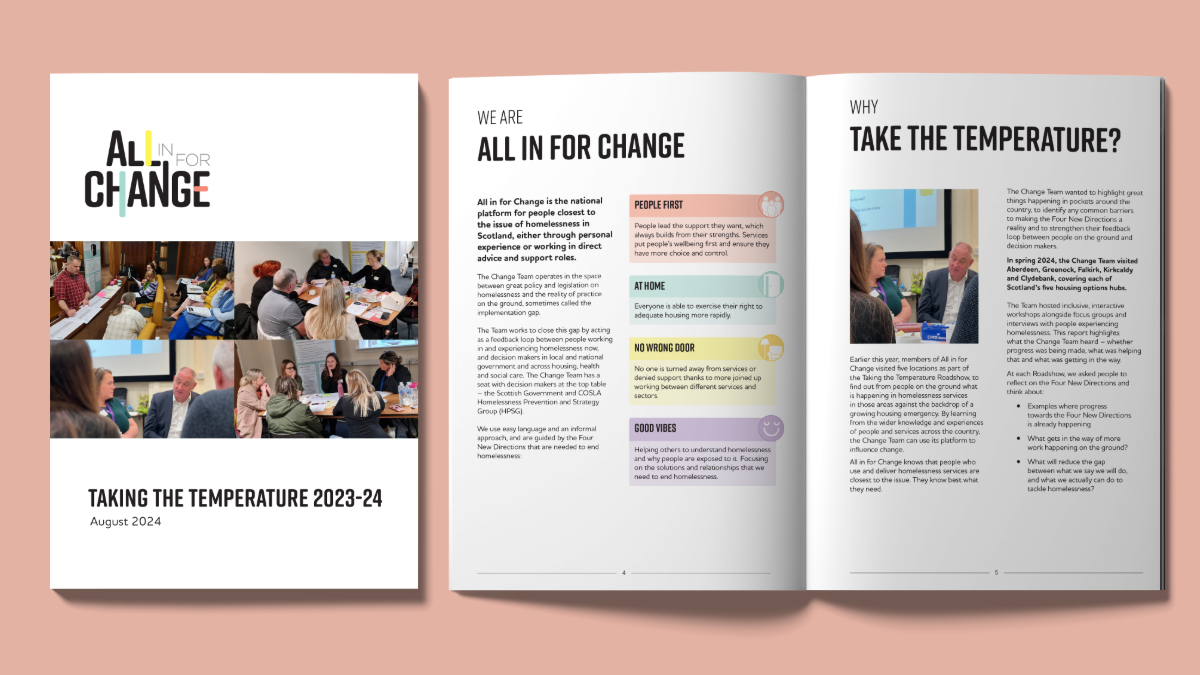
Earlier this year the All in for Change team’s Taking the Temperature National Roadshow toured the country to find some answers to those questions.
The Change Team spoke to 146 people on their travels to Aberdeen, Clydebank, Falkirk, Greenock and Kirkcaldy, including frontline workers and people who have experienced homelessness as well as local authority staff, managers and councillors.
They wanted to hear directly what’s going on across the 5 Housing Options hubs, and gauge progress towards achieving All in for Change’s 4 New Directions – the priorities the Team has identified that will make services work better for people.
This report sets out what the Team heard and fed back to colleagues on the Scottish Government and COSLA Homelessness Prevention Strategy Group last week.
Their evidence is captured in 8 calls from the frontline of the housing emergency – what needs to happen now on prevention, housing supply, culture change, caseload levels, creating more joined-up services, harnessing community assets, and more.
All in for Change is made up of people who know what homelessness looks and feels like through experience. Homeless Network Scotland and Cyrenians facilitate All in for Change, which is funded by the Scottish Government and Frontline Network.
By learning from the wider knowledge and experiences of people and services, the Change Team can use its platform to influence change. And by supporting their findings, you can be a part of that ambition too.
The Supported Housing Task and Finish Group, appointed by Scottish Government and COSLA, has published its final report, recommending that national and local emergency plans should prioritise work focused on reducing temporary accommodation and the better targeting of shared and supported forms of housing.
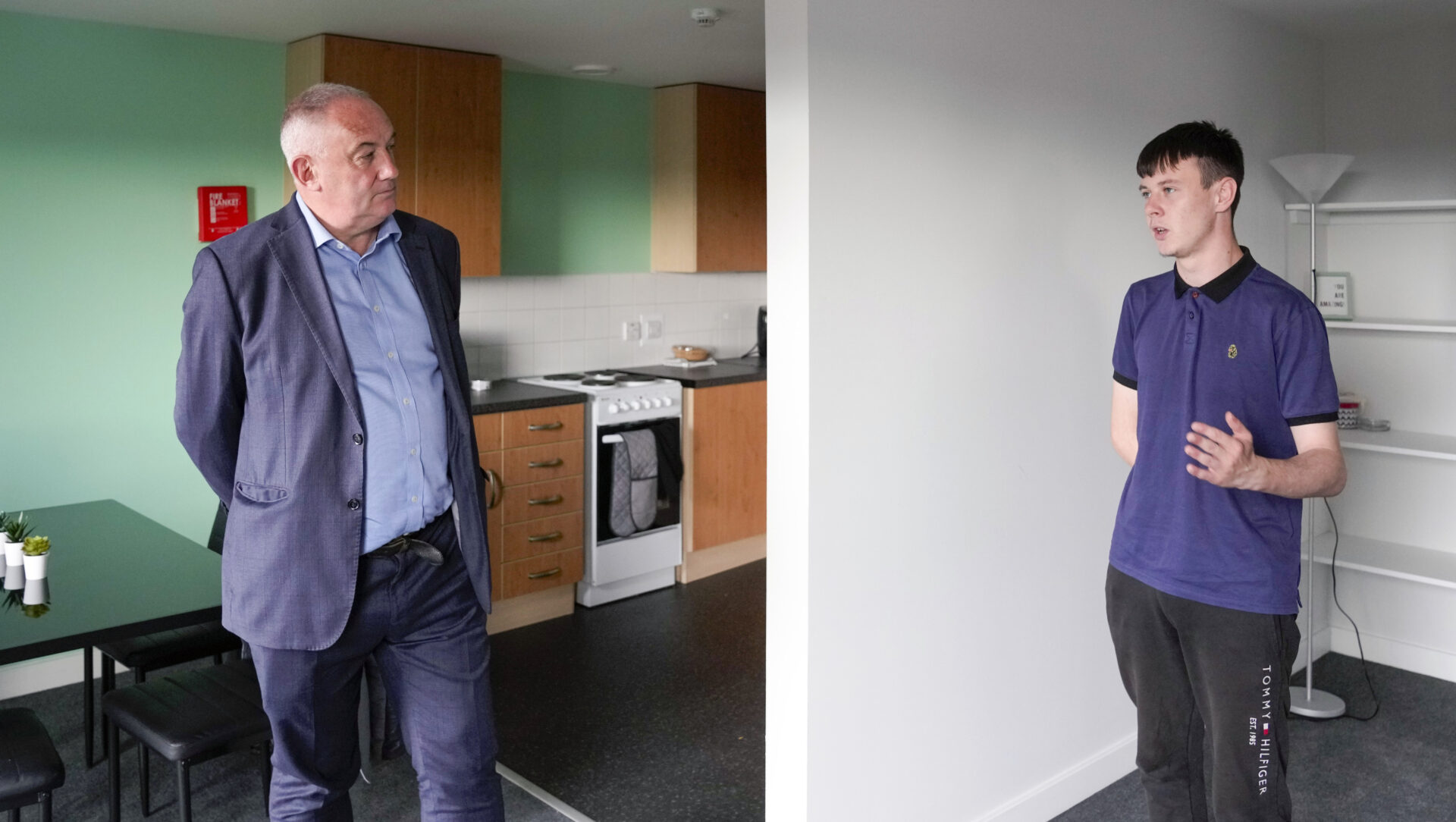
The report was launched at Queens Cross Housing Association’s Wellbeing for Young People service in Glasgow on 24 July.
Housing Minister Paul McLennan, left, toured the modern facility which gives people aged 16-25 self-contained accommodation with flexible support, and chatted with residents.
This was followed by a webinar that offered an overview of the report from Homeless Network Scotland chief executive Maggie Brunjes and Scottish Federation of Housing Associations policy lead Eileen McMullan, who co-chaired the Task and Finish group, and a panel discussion and Q&A.
The minister praised the facility and told the Glasgow Times there could be opportunities for social investors who the Scottish Government has met with to get involved in similar projects.
The report charts a new direction to position supported housing more confidently among the range of housing options available. It recognises that most people can build and live their lives in an ordinary home as part of an ordinary community, but that supported housing should be available for a very small proportion of the population who are unable or don’t want to live in mainstream housing.
This should be a settled housing option for as long as someone wants it, and therefore breaking the stigma of ‘homeless’ supported housing altogether. The research clarified that people don’t want to share a bedroom, bathroom or kitchen, but do want the option of shared spaces.
The group also set out a vision of the best spaces for people to live in, the support on offer, and the funding and commissioning challenges and changes needed to make the report’s aspirations reality. Its report follows a comprehensive review over 14 months that drew on new research of people using shared accommodation and a survey of local authorities.
Key recommendations from the evidence-led review include:
An ideal model of supported housing offering a self-contained home in a smaller-scale setting, with its own bathroom and cooking facilities, easy access to great support, some common space, and consistent quality standards.
Maximising security of tenure for tenants plus fair funding arrangements to make sure no one is stuck in a life-limiting ‘benefit trap’ created by high rents.
Moving to a joint funding and commissioning model between health and social care partnerships and local authorities, to break the ‘care group’ stigma attached to supported housing’s legacy as shared ‘homeless’ accommodation.
The Task and Finish Group report provides recommendations to the Scottish Government, local authorities and housing providers to create a model that enables social landlords to remodel or reprovision existing models of supported housing.
The group built on work in the Shared Spaces research which clarified the role of supported or shared housing as a settled home option for the 2 to 5 per cent of homelessness applicants who are locked out or opt out of a mainstream tenancy.
The review was informed by evidence from expert contributors on housing and support themes, a survey of 19 local authorities providing supported accommodation across Scotland, case studies of existing good practice, and lived experience expertise.
Shona Stephen, QCHA chief executive, said: “We’re delighted to welcome the Housing Minister to our new housing development for young people. We are very proud of the exceptional quality of accommodation provided by Queens Cross Housing Association and by its Housing First for Young People support team.
“We work together to provide homes for young people and the support needed to allow them to flourish in their tenancies. Our success is rooted in kindness, in never giving up and in a shared commitment to our young people across the organisation from staff to Board Members. The benefits of close collaboration between the support team and the landlord can be seen in the successes achieved by the young people themselves.”
Maggie Brunjes, Homeless Network Scotland chief executive, said: “Homelessness policy has undergone radical modernisation in recent years and transforming the way supported housing is used to support a small group of people is the final piece of the puzzle.
“While this report arrives in a landscape dominated by the housing emergency, it sets out all the evidence and the steps needed to reframe supported housing as an option that will help to address homelessness for people facing a range of social, health and economic disadvantages. Queens Cross Housing Association provides an excellent example of how that is done.”
Housing Minister Paul McLennan said: “I welcome the publication of this report, which explores how supported accommodation can make a positive contribution to preventing and responding to homelessness.
“The Scottish Government remains committed to tackling homelessness and improving the supply of social and affordable housing in Scotland. We will carefully consider all of the recommendations set out in the report and will respond in due course.”
Sally Thomas, Chief Executive at the Scottish Federation of Housing Associations said: “It’s essential that our housing system is fair and meets everyone’s needs, particularly at a time of a national housing emergency and record homelessness.
“This vital report sets out the importance of a joined-up, multi-agency approach and one of the core aims is to help to reduce the stigma of supported housing.
“Queens Cross Housing Association, like many SFHA members across Scotland, not only provide high quality, warm, affordable homes, they also offer a vital lifeline in supported housing to help individuals overcome many of the barriers associated with homelessness.”
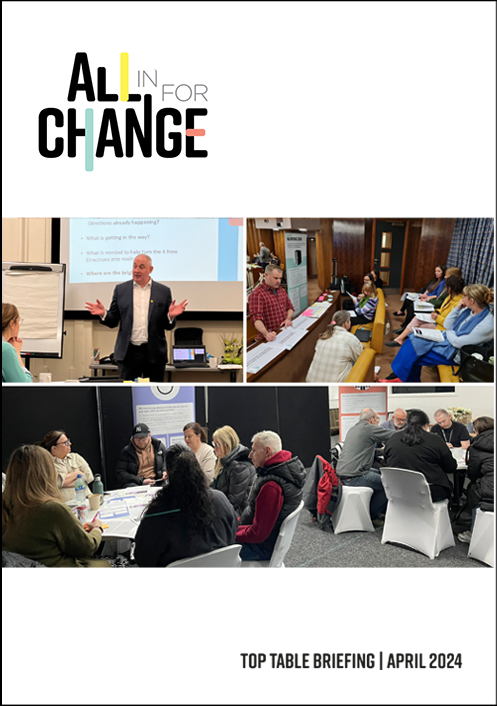
The latest All in for Change briefing to the Homelessness Prevention and Strategy Group sets out what the Change Team wants the Scottish Government to know about and prioritise to bring about positive change in homelessness services.
April’s report also shares some of what the team learned about the state of homelessness services – the good and not so good – during the recent Roadshow, which visited five locations. This snapshot of what’s happening came through interactions with more than 100 people who came to the events, including many frontline workers.
Read the report [PDF] to find out what the team’s top priorities are and more.
Argyll and Bute Council has detailed key outcomes from a Housing Summit held after it declared a housing emergency last year. The summit brought together 90 partners from public, private, third and community sectors who pledged their support to take action to address the housing shortage. Read more here.
Edinburgh and Glasgow also declared housing emergencies at the end of last year. In Glasgow, The Ferret news outlet and Greater Govanhill Community Magazine recently hosted an Open House session for experts, local people and people working in the housing and homelessness sectors to explore issues and solutions. Read a summary of the event.
Meanwhile, Fife has become the latest local authority to follow suit and declare its own housing emergency amid “unprecedented pressure” on housing and homelessness systems in the area.
The council recently agreed a three-year plan to tackle homelessness which highlighted the need for an estimated £67.3 million to help the escalating number of families without permanent housing. Full details here.
New start housebuilding among housing associations has plummeted to its lowest level since 1988, official figures show. Social homes made up around a quarter of completions in 2023, a drop of 18% on the year before, and starts fell by 35% in 12 months.
We use cookies to ensure that we give you the best experience on our website. If you continue to use this site we will assume that you are happy with it.
You can revoke your consent any time using the revoke consent button.