The future for Shared Spaces

Claire Frew, Homeless Network Scotland

Since I joined the sector in 2004, congregate supported accommodation has played a big part in our common responses to homelessness. While some of the provision has changed over time, questions about its purpose as a response to homelessness, as well as its advantages and disadvantages, have remained. The policy shift to a nationwide focus on Rapid Rehousing and Housing First is the first time I really remember fundamental questions being asked about what we are trying to accomplish.

This new policy agenda has seen our efforts focused firmly on providing people with their own safe, secure homes as quickly as possible. And through Housing First this includes people who experience homelessness alongside trauma, mental ill health, and substance misuse; people who might otherwise have been spending time, sometimes long periods of time, in supported accommodation. As we continue to deliver rapid access to mainstream housing and, based on Housing First principles we reject the belief that people need to spend time in supported accommodation to become ‘housing-ready’, we were pleased to bring the sector together to think through what we offer to the small number of people whose needs cannot be met in mainstream housing, even with Housing First support.

The Shared Spaces research project offered an opportunity for us to start asking some big and challenging questions, knowing that while we might not always be able to answer them definitively, that we’d at least move a step forward. The research fieldwork took place during 2021 and at Homeless Network Scotland we offered as many opportunities as we could for people to come together to ask questions and share their views. As always, the position we have reached today is stronger because of the sheer number of people who took the time to get involved.

So what did the research find?

That the common circumstances where mainstream housing may not be possible or preferable are when people have a range of overlapping needs such as mental ill health, physical or learning disability, and experience of criminal justice. This is linked to the recent interim evaluation of Scotland’s Housing First Pathfinder which found that Housing First is not successful for people who lack the capacity to understand the terms of tenancy agreements, people who have very high healthcare needs, and people who don’t want Housing First.

That key features of supported housing include that it is self-contained, maximises security of tenure as a settled rather than temporary housing option, has a culture of rights and independence, offers skilled and flexible support, is delivered in a core & cluster model, is small, and is integrated in the community

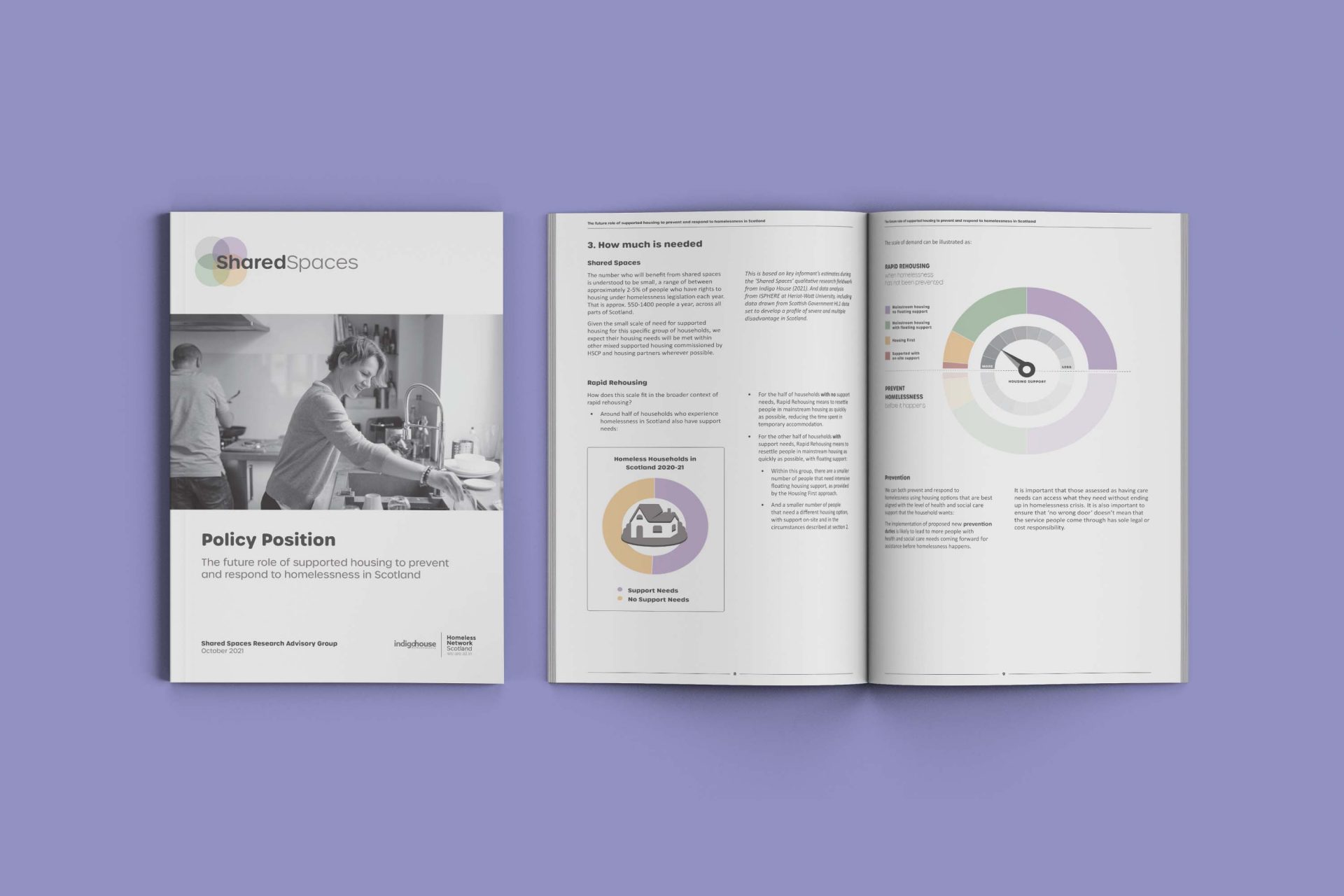
That in terms of scale it is estimated that between 2% and 5% of people assessed as homeless would benefit from this type of settled housing option. This would be equivalent to 550 to 1400 people nationally.

In response to the research findings, our next task is to develop a transformation programme that moves us away from shared, supported accommodation to meet temporary accommodation duties, toward health and social care led supported housing as a settled housing option for a small number of people using homelessness services who need or want long term care on-site.

This will require significant thinking about the role of Health and Social Care Partnerships, resources, and commissioning. But it’s the next part of the transition to rapid rehousing that we look forward to completing.
Veterans Homelessness

3 November 2021 | 10am – 11:30am

The pathway to prevent and end homelessness for people leaving the armed forces in Scotland

Presented in partnership with Veterans Scotland, this Homeless Network Scotland Member Event is an opportunity to input into the pathway to prevent and end homelessness for people leaving the armed forces in Scotland.

Kevin Gray, CEO of Veterans Housing Scotland and chair of the Veterans Scotland Housing Group and Dr Steve Rolfe, Lecturer in Social Policy at Stirling University, will present the draft report for the first time publicly. This will be followed by a Q&A when the team want to hear your experience of veterans’ homelessness and your views on what needs to be done to address the housing needs of former services personnel.

In 2020 The Scottish Government requested the support of the Veterans Housing Scotland to explore, investigate and recommend a pathway to end homelessness for people leaving service and former service personnel already established in civilian life. The remit and approach of the project includes:

The definitions of homelessness

Transition from service and the barriers to housing

Establishing the experience of other homelessness projects and their impact

Data sources and the availability of accurate information

Register Now

Choice: Conference now open for sponsorship opportunities

We are proud to host Scotland’s largest knowledge and networking events on ending homelessness. 

This year Choice will cover three themes over 3 days – Housing ChoiceSupport Choice, My Choice. We will be exploring how we ensure real-world options match the national policy ambition – and how we exercise choice and control when options are sometimes limited. 

Join us as an event partner, sponsor or exhibitor across 3 dynamic days (5-7 October). We are using a specialist conferencing online platform ‘Remo’ to reach further and more creatively – and to make sure every delegate gets a unique conference experience.  

Find out more about the conference and how you and your organisation can be centre stage. 

Poverty and Inequality Commission strategy published

Recent experience has sharpened the impacts of poverty and inequality. However the underlying issues reflect pre-existing inequalities. The Strategic Plan published this month by the Poverty and Inequality Commission sets out how the Commission will advise, support and challenge partners to embed the shared commitment to addressing poverty and inequality and translate it into action through five priorities.

In Strategic Priority 3: Advocate for a response to COVID-19 that addresses the structural causes of poverty and inequality, the Commission pledges to carry out work to look at the longer-term impacts of the pandemic on the key levers to address poverty: work and earnings, social security and housing. The report overall reinforces what we know, that poverty and inequality are not inevitable and that it is possible to redesign society to addresses the structural inequalities leading to poverty and create a fair and sustainable economy. The strategy highlights thatthe Scottish Government has provided a lifeline to those who are struggling by investing in food security and community well-being, housing people who are homeless, and providing additional payments to carers during the pandemic. But significant challenges remain, and this strategy commits to ensuring that reducing poverty and inequality is central to policy making and delivery in Scotland. More information here.