Why we’re #AllIn for CoPro: ‘I’m very proud to be part of this’

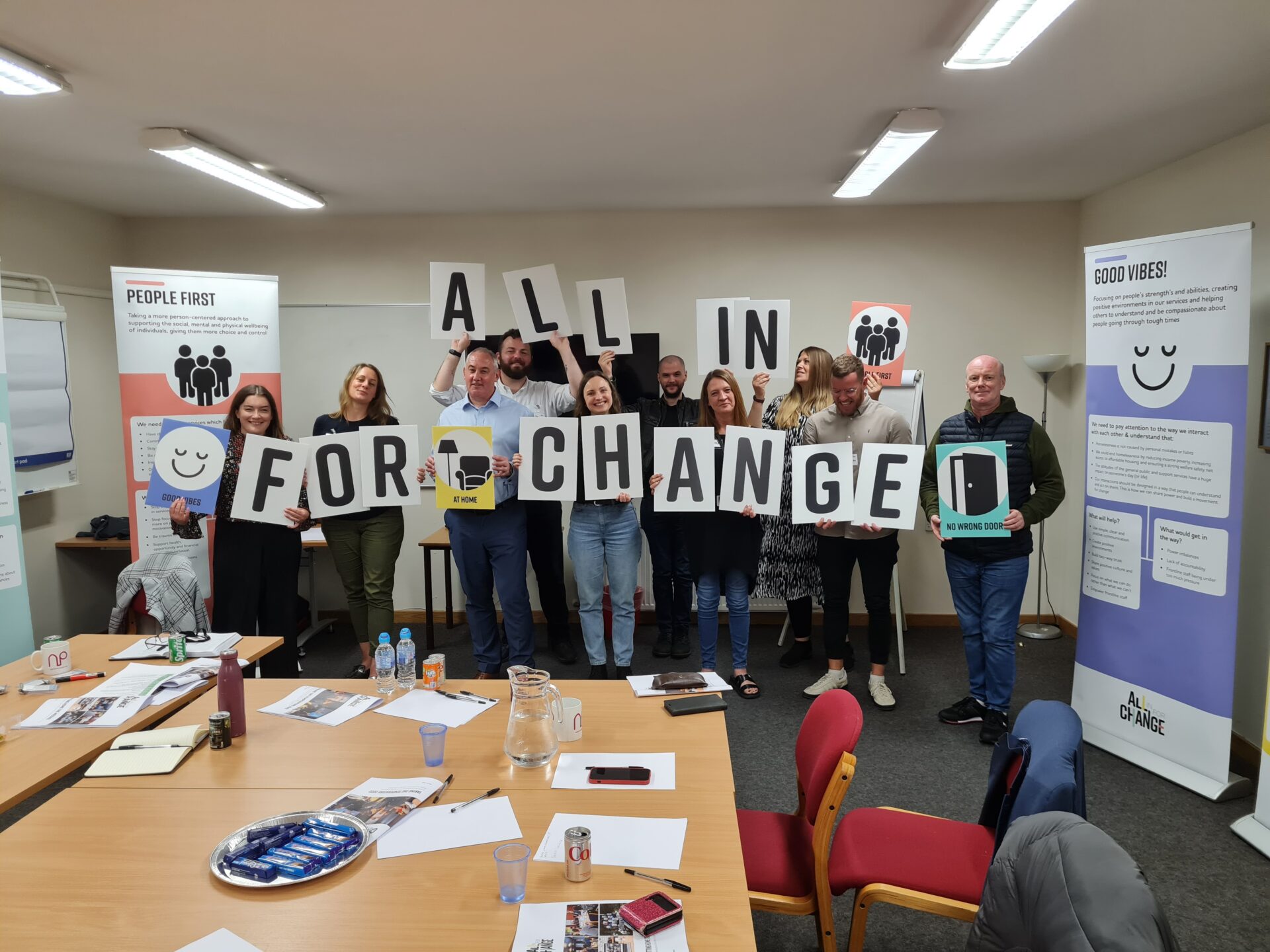
Co-production Week is all about showcasing examples of CoPro, so let’s talk about All In For Change — a collective created four years ago to challenge the systems built up around homelessness.

The Change Team is made up of people with experience of homelessness, policymakers and frontline workers. If one definition of co-production is “combining everyone’s strengths to achieve positive change”, All In For Change is a great example of putting that principle into real action.

Since 2019 the team has been using its wide-ranging expertise to help achieve objectives set out in the Scottish Government-COSLA Ending Homelessness Together Action Plan.

Change Leads work with decision makers in local and national government to develop policy — one of its biggest successes has been developing prevention duties proposed for public bodies, intended to be written into law in the forthcoming Housing Bill.

Key aims of the programme, facilitated by Homeless Network Scotland, Cyrenians and Scottish Community Development Centre, are bringing about co-ordinated working between different services and ensuring support services take a person-centred approach.

To mark Scottish Co-Production Network’s #CoProWeekScot, Change Leads have shared their experiences of working as part of #AllInForChange — starting with Amanda Rutherford, an Engagement and Assessment worker at Crisis.

I became involved with the Change Team in Autumn 2021. I was intrigued by the concept that, as a frontline worker, I could be part of something that could make a difference to homelessness in Scotland.  Change Leads bring different experiences and knowledge to the table from across the country.

The way the Change Team was created results in an equal and level playing field so that everyone, regardless of their background, has a voice and their opinion is respected. 

Mutual respect and being open to learning leads to a positive environment which enables co-production and lively debate. This has led to ideas, such as ‘Ask and Act’, being introduced to the Scottish Parliament as part of the upcoming Housing Bill — a direct result of collaboration within the Change Team.

Co-production brings real benefits to ending homelessness in that those who see the reality of homelessness in Scotland on a day-to-day basis can influence government policy. The Change Team are an incredible team who work well together, and I am very proud to be part of this.

The All In For Change team’s successes and future priorities are set out in this evaluation of the programme’s first three years.
13 new HNS Associates join drive to end homelessness  

Homeless Network Scotland has welcomed 13 new Associates from across Scotland who will use their personal experience and insight to combat homelessness – significantly bolstering the team.  

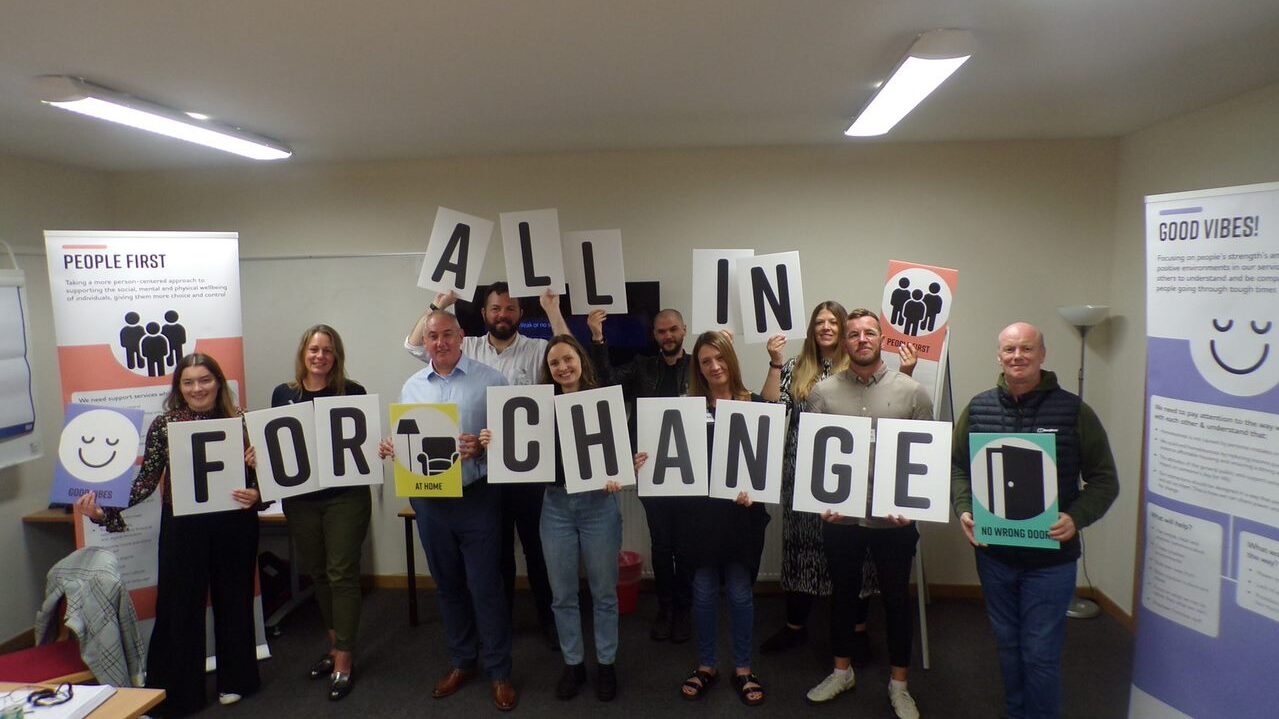
The new recruits will join eight Associates working on the nationwide All in for Change programme and the Glasgow Homelessness Involvement and Feedback Team (GHIFT). 

At a series of training sessions in August and September the latest additions have been getting to know their new colleagues and finding out more about their roles and the impact they could have. 

New members shared their feelings about joining the team, with one stating simply: “Let’s work to end homelessness”.  

Among the other messages were “I am excited to work for HNS, creating change for individuals and society. A heartfelt organisation wanting the best for all!” 

Other Associates told of their hope that they would be “involved in making homelessness a less traumatic, frustrating experience” and being able to “push for change”. 

Homeless Network Scotland’s Associate programme provides a platform for people whose life and professional experiences give them invaluable on-the-ground knowledge of homelessness. 

The paid team members get a chance to learn more about and influence policies and practices, connect with politicians, policy and decision makers, and act to achieve change. 

Associates are perfectly placed to find better solutions and highlight what is working and is not, while using their role to build a network of contacts and gain valuable new skills and knowledge. 

All in for Change is an informal and inclusive umbrella group that brings people together to help end homelessness by gathering and sharing information as well as hosting events and roadshows.  

The programme is built on four directions – taking a people-centred approach, ending siloed services, pushing for rapid access to good housing, and fostering a positive, compassionate outlook. 

Change Team members have personal or frontline experience of homelessness and provide briefings covering priority areas such as health and wellbeing and poverty and social justice. The team is represented on the Scottish Government Homelessness Prevention Strategy Group (HPSG).  

GHIFT members who have experienced homelessness lead on changes taking place across services across Glasgow. Members host meetings, events and workshops for people with current or recent experience of homelessness and work with decision makers to ensure their voices are represented. 

“We are delighted to welcome 13 more Associates to Homeless Network Scotland and can already see how their diverse experiences and insights will build on the positive influence the team wields. 

Associates have the opportunity to speak truth to power as a critical friend to policymakers and to help anyone experiencing or at risk of homelessness. Their collective, expert voice guides everyone working towards the achievable goal of preventing and ending homelessness in Scotland.” 

David Ramsay, Impact Lead

Homeless Network Scotland statement on the disbanding of the Glasgow Alliance to End Homelessness

Homeless Network Scotland is saddened to learn Glasgow Alliance to End Homelessness has disbanded. This is a painful time for colleagues who have worked so hard and with such ambition to end homelessness in the city and change the story around homelessness.

The Alliance and Glasgow City Health & Social Care Partnership can stand tall having tested a truly collective approach that put people who have been homeless at the centre of decision making. Acknowledging the impossible challenges wrought by the pandemic and taking this difficult decision is equally courageous. The learning must be reviewed and shared so that progress can be made.

This is a hard knock for members of GHIFT, the platform for people with lived experience of homelessness who are supported by Homeless Network Scotland. They have put their heart and soul into exploring ambitious new ways to deliver services and achieve systemic change, driven by their invaluable first-hand insight.

But GHIFT will continue to inform and influence the Health & Social Care Partnership’s homeless strategy and delivery. Homeless Network Scotland will continue to provide strategic partnership and support to both bodies and create opportunities for everyone in the third sector to work together in tackling homelessness.

We will build on the knowledge and connections that flourished through the Alliance to pursue our shared ambitions. There is still much work to be done to end homelessness in Glasgow and Scotland – in the face of the cost of living crisis and rising homelessness this has never been more important.


Martin and Mark from GHIFT reflect on being part of the Alliance. Read their blog here. [pdf]

The Housing Minister meets All in for Change

Members of All in for Change were delighted to be invited to meet new Housing Minister Paul McLennan this month. Having built positive working relationships with his predecessors, the team were clear that this was to be the first of many conversations, and focused on building a relationship that would have impact.

To bring the Minister up to speed on the work of All in for Change, the team shared the key messages from the last national roadshow, ‘Taking the Temperature’. The team informed the Minister that people are seeing progress, despite increasing pressure on the system due to housing challenges, covid recovery and the cost of living crisis.

The team had four asks to close the implementation gap between our progressive homelessness policy and the reality of homelessness services on the ground:

  1. Put people first by ensuring services are person-led, designed to meet the needs of people who are accessing support rather than designed to meet the needs of the systems or the organisations that work in the system.
  2. Less competitive tendering with a shift towards ethical commissioning models that encourage partnership between services. Longer funding cycles will allow longer contracts, more stability for practitioners and better relationships with the people they support.
  3. Better, fairer housing with more innovative approaches to increase the supply of good quality social housing and to create real choice in where people can live and build a good life. This would alleviate the pressure on temporary accommodation, meaning fewer transitions for people and a faster resolution to their experience of homelessness.
  4. Support for frontline workers because to provide quality services we need practitioners who are supported and empowered. This includes paying good wages, providing training, encouraging reflective practice, making people feel part of a team. More investment in staff wellbeing, keeping caseloads low to prevent burnout.

The Minister welcomed these messages “from the ground” and encouraged the team to continue bringing life to these issues through their personal and professional testimony. It was clear from the very beginning that the Minister shares the same values as the Change Team, he wants to understand what’s happening in reality as well as in policy and legislation. The Change Team are the perfect mechanism for this information to flow from communities back to the Minister, which is an exciting opportunity for both parties.

Going forward, the Change Team have highlighted four areas of focus and shared these with the Minister to get his take:

  • Homelessness prevention as a focus given the new prevention duties on public bodies to Ask & Act, and how those without a duty can strengthen efforts to prevent homelessness closer to home, in communities.
  • The team want to focus energy on influencing across the country to improve the quality and reduce the scale and use of temporary accommodation in Scotland.
  • In order to reduce the use of temporary accommodation we need increased housing supply, particularly in areas where there is significant housing pressure.
  • And encompassing all of the above, the team will be focusing on the No Wrong Door concept, advocating for stronger coordinated working between different services, with clearer pathways for those most at risk and no one turned away.

It seems that All in for Change and the Housing Minister are very much on the same page, with Minister McLennan sharing details of his future plans, including setting up a cross-ministerial oversight group which will be a strong catalyst for creating a system with no wrong door.

If the aim going into this meeting was to begin a positive relationship, the number of smiling faces at the end of the meeting would indicate a success! The Minister has asked to come back to All in for Change in a few weeks time to continue pushing forward towards the reality set out in the Ending Homelessness Together Action Plan.

Watch this space.

Blog: Amanda and David – focus on what works to drive change

Two Change Leads from All in for Change, Amanda Rutherford and David Pentland, share their reflections on facilitating the national roadshow.  

In helping to produce ‘Taking the Temperature’, the latest report from the All in for Change roadshow, we held workshops and focus groups across Scotland to find out more about the current reality of the homelessness system. We were delighted to engage with more than 100 people working in homelessness and using homelessness services and we owe our heartfelt thanks to those who took the time to come along and share their views on working or being cared for in many different homelessness settings.  

What was apparent in every conversation was a mixed bag of participants with lots of sectors represented and common themes emerged when we talked about challenges, such as the well-known challenge frontline workers and people experiencing homelessness face when services don’t interact with each other. A particular example that we heard in many different places was the lack of connection between mental health, addiction, and homelessness services.  

We also made sure to hear about the good stuff – the more we talked with different people, in different places, the more we learned about the brilliant work currently taking place.  

Whether that’s Aberdeenshire’s use of remote appointments to remove barriers to people making homelessness applications, or South Ayrshire’s approach to providing wrap-around support in Housing First, we found examples of inspirational work taking place all over Scotland. 

In Edinburgh, Cyrenians are running a hospital in-reach programme with the NHS to help patients and staff navigate the homelessness system and prevent discharge into homelessness, while in Kilmarnock, a wellbeing unit within the police is focusing on early intervention, to tackle the root causes of homelessness. 

The list could go on and on – there just isn’t space to cover them all in one blog. But while there are countless examples of good practice taking place at present, it is also clear that many of these projects do not get the recognition they deserve. That means, all too often, good practice in one area is not replicated in another.  

In that context, it is vital we coordinate – that we work together, to learn from each other – to move towards more joined up services, where good practice in one area inspires the same quality of delivery in another. It is also vital that people with experience of homelessness drive this change. 

Because listening to people with experience of the homelessness system can never be an after-thought. People with lived experience of homelessness, and those with expertise from delivering frontline services, must play a central role in mobilising plans for ending homelessness.  

The homelessness system needs to work for the people who need it. That means we need to make services more streamlined, with better links between different sectors – such as health, justice and housing – as well. 

If we do that, we can build a system that works for everyone. 

The full Taking the Temperature report can be found here.  

All in for Change are recruiting new members! If you want to be part of this team, using your experience to collaborate with decision-makers and engaging with people using and providing services, get in touch for an application pack – changeteam@homelessnetwork.scot