March and April training bulletin

Since the last training bulletin, we delivered a refreshed equality and human rights course which learners described as “superb” and launched our very first blended rough guide course as flexible eLearning and a live workshop.

We also finished a series of four lectures to trainee doctors and medical students, sharing the stories of people experiencing homelessness and the transformational impact that medical teams can have when they are more human. 

Here is a summary of what is coming up in March and April, perfect for lifelong learners, actioning your annual appraisal or for designing a team training plan.  

What’s new?  

  • Join Clan Childlaw for a short training session about the new law that public authorities need to be compliant with to ensure children’s rights are fully realised. Reserve a ticket for 30 April.  
  • Our brand-new digital learning space is ready for you to explore and perfect for staff, volunteer and board inductions. Get in touch to talk about delivering one of our courses or something bespoke across your organisation.  

 
Upcoming Homeless Network Scotland training dates 

We bring good vibes, a blend of direct and academic evidence, and you bring the questions. Our online training sessions are a great opportunity to network, share examples of good practice and learn from experts.  

  • Homelessness stigma; a conversation 18 March 
  • The unequal risk; an equality and human rights lens on 3 April 
  • Trauma informed approaches; beyond buzzwords to better outcomes 24 April 

Training and events about navigating the immigration system 

Navigating the immigration and housing system is increasingly complex, especially with new immigration rule updates that mean people who arrived seeking safety in the UK via a dangerous journey will normally be refused citizenship. There are lots of helpful events to better understand people’s rights and eligibility to public funds, including housing and homelessness assistance.  

  • Free series of trainings about resisting the hostile environment in public services with Social Workers Without Borders, Migrants Organise and PAFRAS. Running March – July and starting with The Power of Words: Reframing the Migration Narrative on 18 March  
  • Free seminar to celebrate World Social Work Day with the Scottish Association of Social Work about supporting young people seeking asylum in the UK, on 20 March 

Wider training and webinars for the homelessness workforce 

  • Frontline Network run a series of free training for the workforce including suicide awareness and professional resilience 

To suggest a training topic you would like to see on our programme, or to send us details of webinars, learning events or workshops for including in the next training bulletin, please email laura@homelessnetwork.scot 
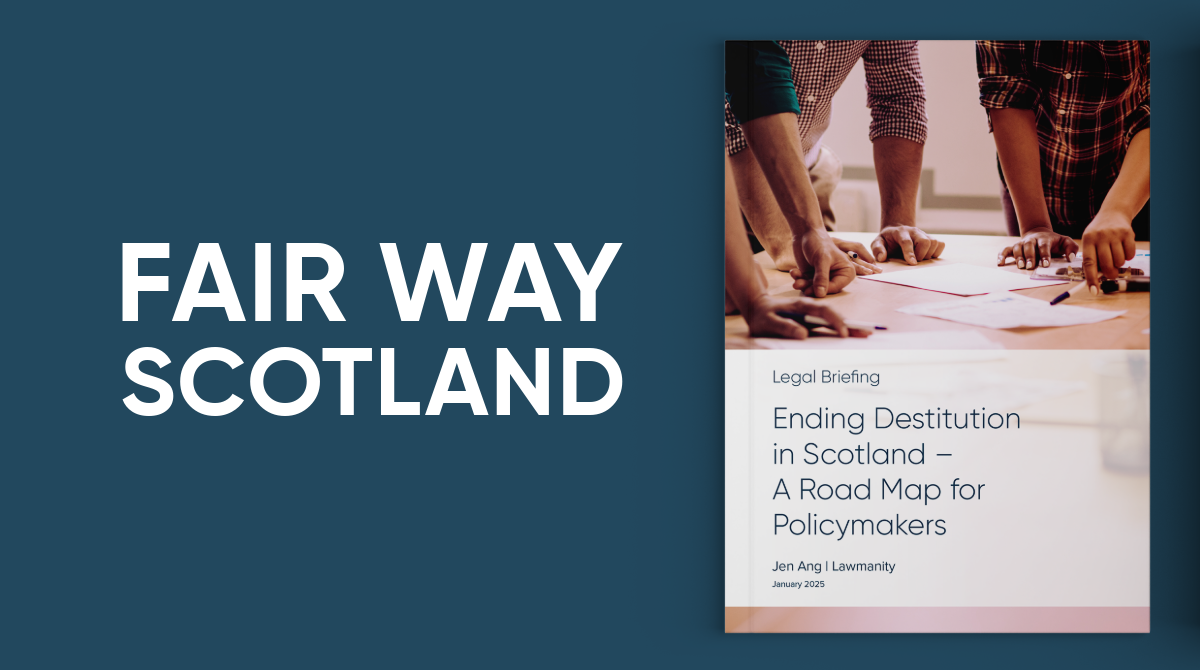
Ending destitution: a road map for policy makers

A new legal briefing sets out steps the Scottish Government and local authorities can take now to mitigate the harm caused to people in Scotland by UK immigration policy.

Ending Destitution in Scotland: A Road Map for Policymakers was commissioned by the Institute for Social Policy, Housing and Equalities Research (I-SPHERE) and Joseph Rowntree Foundation (JRF) through their role in Fair Way Scotland, a partnership working to prevent homelessness and destitution among people with No Recourse to Public Funds (NRPF).

The briefing by Jen Ang, for legal and strategic consultancy Lawmanity, follows the latest Fair Way Scotland evaluation report Destitution by Design, which sets out the terrible impact of the UK immigration system on people who come to Scotland to work, study, join family or seek safety.

This legal route-map argues that Scottish Government and local authorities can take positive steps to end this situation across seven areas that deliver essential support to people: social security and financial support, housing, transport, health and social care, education, work, justice and legal aid.

It challenges presumptions that reserved immigration law prevents specific groups from accessing support that would mitigate the harm they suffer at present, by presenting workable solutions that national and local government could pursue to achieve immediate positive change.

More broadly, the briefing recommends that decision makers in Scotland can fulfil their commitment to ending homelessness and destitution by reviewing and if necessary redesigning devolved policy, working with the UK Government to define ‘public funds’, improving frontline practice, and establishing parallel systems of support.

Commitment to housing rights by Shirley-Anne Somerville MSP

The Everyone Home collective and All in for Change wrote to Cabinet Secretary for Social Justice Shirley-Anne Somerville at the end of last year asking for a commitment to preserving our housing rights.

These protections have been built up over 25 years of devolution but are under threat because of the housing emergency. But this crisis is not, and never can be, an excuse or cover to water down people’s rights.

The right to a safe home is not something just for times that are easy. It is when times are tough, when councils need to decide between one priority or another, that rights come into their own.

The Cabinet Secretary has now responded to the collective and the Change Team with a letter committing to our rights. 

Ms Somerville says: “They are key elements of Scotland’s strong rights for renters and homeless households and part of the protections in place to ensure homes are safe and suitable.

“I am clear that changing or suspending their application would risk regression and expose people to unsafe or unsuitable accommodation.

“As I mentioned in my previous letter, I am very proud of the rights that exist in Scotland for people experiencing homelessness and I can therefore assure you that I do not intend to pursue any changes to legislation.”

Read a comment piece on why we must go forward, not back on housing rights.

Why workforce wellbeing matters and what you can do 

At the busiest time of year for the homelessness workforce, it is more important than ever to centre collective care in our work, says Homeless Network Scotland Learning Lead Laura Ffrench-Constant.


We all know why worker wellbeing is important.  Happy and resilient workers lead to better outcomes for the people they work with who are experiencing homelessness. It also means less sickness, absence and staff retention. It means people feel valued and respected. 

However, as the latest Frontline Network worker survey highlights, there is more work to do to improve the wellbeing of the homelessness workforce.  

It found that 64% of workers felt that their role has a negative impact on their wellbeing. Just over half said they often or always feel at risk of burnout. Wellbeing was the most likely reason cited for people who do not want to continue in their role.

Not everything can be solved with workplace yoga or signposting access to free counselling.  

During a fringe session about wellbeing at the annual homelessness conference in Perth in October, we shared good practice examples from organisations across the network.

These included peer supervision, group reflective practice led by trained professionals, line managers incorporating wellbeing check-ins, dedicating time for team building and protected time for training.

Managing the workload of emergency cases and dedicating budget to wellbeing activities – and salaries – is also important. 

There are lots of useful resources across the web that workers, line managers and leaders can use.  

  • BeWell’s wellbeing toolkit designed for organisations working in the migration space includes workshop templates, policy templates and a directory of support 

Over the summer we facilitated play-based workshops for over 100 housing workers about wellbeing. We gathered together people from different organisations to share ideas, experiences and laughter; and the main takeaway people shared was that they felt less alone and comforted that we experience some similar challenges. 

Join us on 6 February for a creative and relaxed in-person workshop in Glasgow, generating solutions and ideas for workplace wellbeing. Priced at £50 per space for HNS members and £70 for non-members. You’ll find more information and testimonials on the booking page.

If your organisation doesn’t have budget for training, please get in touch at hello@homelessnetwork.scot or take a look at the Frontline Network training fund which is now available for wellbeing training.

Blog: we need to open doors together

The No Wrong Door action learning partnership was launched in September and is testing out how to create cross-sector, integrated services in four places in Scotland, with local results informing a blueprint for joined-up service delivery nationwide.

The programme aims to make it easier for people to get support when they face severe and multiple disadvantage – when their lives are shaped by poverty, trauma, violence or abuse, or they face other barriers including homelessness, addiction and discrimination.

These disadvantages often overlap but the current model of services that are paid for and provided in different sectors doesn’t reflect their reality. It means people often have to share their stories repeatedly to access all the support they need, it’s costly and it deepens inequality. There needs to be No Wrong Door to getting help.

Homeless Network Scotland Head of Partnerships and Consulting Grant Campbell writes about the need to explore how we can join up services to ensure people facing such challenges get the support they need more easily.


All the way through my career I’ve had the privilege of working alongside some brilliant people. At Homework Network Scotland that also extends to those beyond our organisation and to the many partners and collaborators we work alongside. I’m fortunate enough to be connected in with people and organisations doing amazing things in what is currently an increasingly difficult context.

Many people acknowledge that most, if not all of our statutory services are on their knees, and gone are the days of shiny new ‘pilots’ with five years of secure funding to add a new service somewhere. Controversially, I’m glad!

Now I’m not saying that services don’t need money – they do. Our statutory services need significant funding as do our commissioned third sector partners. Yet if all we do is pursue more funding, there will never be enough money to build the system that we need.

How often have we listened to our political leaders talk about ‘record funding’ for their departments? It doesn’t matter – the hole is always bigger than the money we pour into it.

Increasingly in meetings, no matter the agenda, the conversation seems to always drift towards the siloed nature of the work we do in the care sectors. This is the itch that I feel we need to scratch.

Many of us know it, but we all just play along with how we’ve always done things. We fight our corner, compete for our budgets and argue for additional funding for X at the cost of Y.

I’ve yet to meet anyone who disagrees with this, but who’s prepared to take a different approach if you’re the only one? That’s why we need to go together.

As the old proverb goes, if you want to travel fast, go alone, if you want to travel far, go together. I’m encouraged by this, not least because this journey certainly doesn’t feel fast from my perspective.

Homeless Network Scotland has been steadily working with partners across Scotland towards this different approach… towards No Wrong Door.

Together we’re not only testing change, bending rules (might have broken some…sorry) but we’re determined to learn from failing fast, learn from our mistakes, fixing them and move forward.

The ambition is not only to see significant change in the few areas that we’re working in, but also to build a framework from our learning which shapes decision making across Scotland for the future. We imagine an established No Wrong Door Approach Framework which informs funders, commissioners, service delivery, law makers, and many more.

To this end, we’ve established a National Learning Set, which meets again in the new year. Using the Human Learning Systems approach we’re bravely curious about what works and what doesn’t. Learning wht it will take to break down barriers between siloes and creating paths through the maze for others to follow.

In our current context, this isn’t the time for defeatism. I’m not advocating a naïve ‘talking it up’ approach, pretending all is well. Rather, we need to resist the temptation to fold inwards and extend out to others. We not only need to recognise the connection between poverty, education, housing, mental health, community justice, addiction and health, we need to plan, fund and deliver services that address these issues together.

Watch a 3-minute video briefing on No Wrong Door Scotland