Scotland has some of the strongest homelessness rights in the world, but those rights are being fatally undermined by chronic underfunding and a persistent failure to deliver social homes at the scale required. Legislation cannot house people. Only investment can do that – and the forthcoming Scottish budget is an opportunity to make that happen.
Today, more than 17,240 households are trapped in temporary accommodation, including 10,180 children, who are waiting on average 238 days for a settled home.
Behind those figures sit the realities that shape lives for decades: disrupted education, worsening health, exhausted parents and children denied the stability every one of them deserves.
These are not inevitable outcomes. They are the consequence of political choices that the Scottish government now has the power to change.
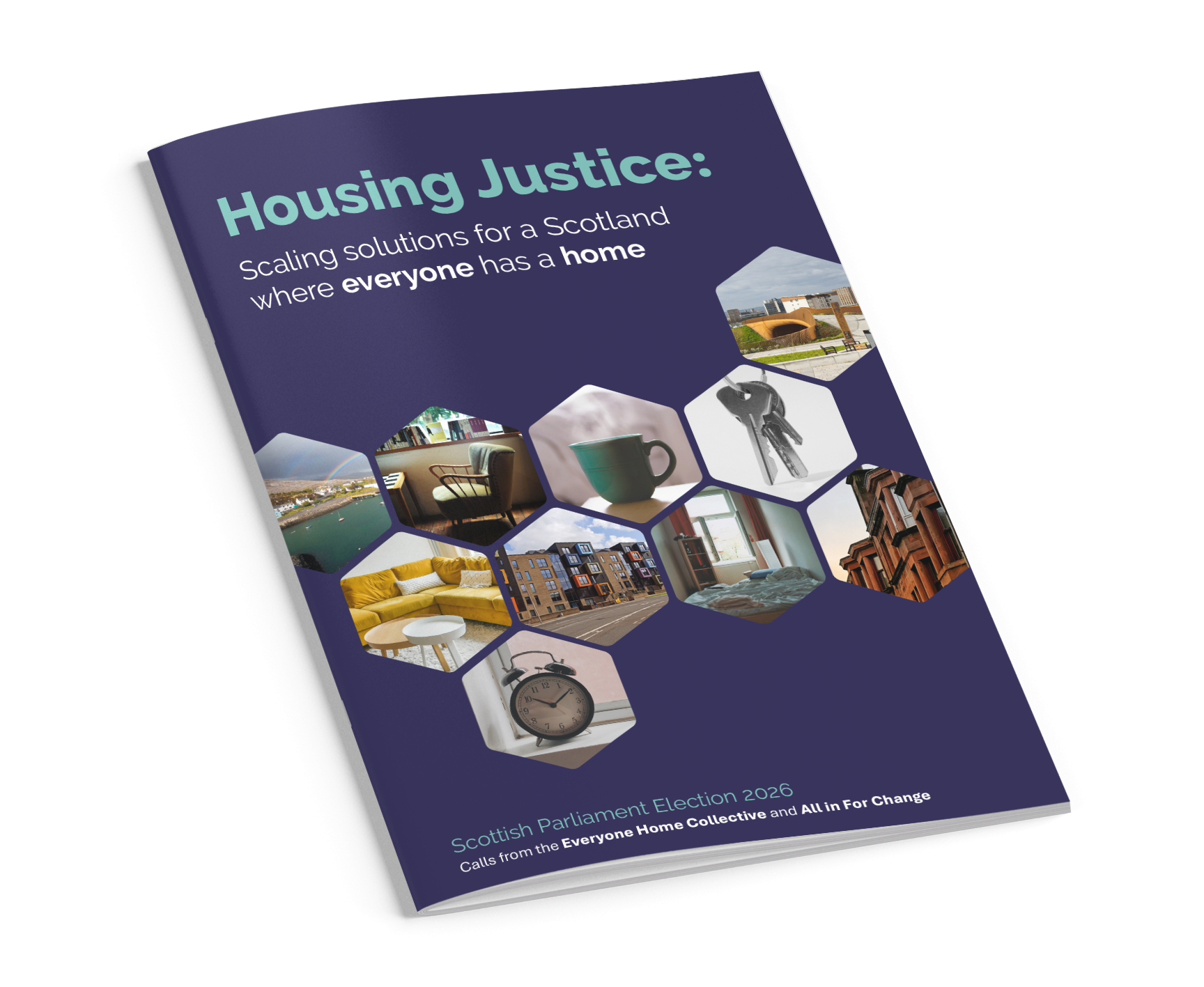
The Everyone Home Collective and All in for Change organisations have set out an election manifesto grounded in lived experience, frontline expertise and rigorous evidence: Housing Justice: scaling solutions for a Scotland where everyone has a home. Its message for the Scottish budget is clear.
Scotland needs a Big Build. We need at least 15,693 new social homes every year of the next parliament, backed by £8.8 billion of capital investment, according to independent research commissioned by the Scottish Federation of Housing Associations, CIH Scotland and Shelter Scotland.
Some in Holyrood claim this scale isn’t logistically possible. We disagree. Yes, challenges exist – but they’re not fixed. Today’s delivery rates – more than 7,000 affordable homes last year – are held back by limited funding and short-term priorities.
Put the full investment on the table with genuine urgency and the building industry, housing associations, planners and supply chains will step up. We’ve seen it before: when Scotland commits with ambition and resources, capacity grows to meet the moment.
This scale is not aspirational. It is the minimum required to reduce the housing need currently affecting 693,000 households, and to relieve pressure on a system spending millions on unsuitable temporary accommodation – hotel and B&B rooms – that leaves individuals and families in limbo. Without a step-change in housing supply, homelessness will continue to rise no matter how well-intentioned our policies are.
But supply is only part of the picture. Poverty, inequality and restrictive UK welfare policies remain the strongest and most persistent drivers of homelessness. When incomes fall short of the most basic cost of living and rents soar beyond reach, people fall into crisis long before they cross the threshold of a homelessness service.
Upstream prevention
That is why prevention must move upstream – and the budget must reflect this. Scotland’s new prevention duties offer real potential, but only if services across housing, health, social care, justice and policing are resourced to identify risk early.
Frontline workers are already stretched to breaking point. They cannot compensate indefinitely for failures elsewhere in the system. A budget committed to housing justice must ensure that the burden does not fall on those already doing the heaviest lifting.
Crucially, it must also shield those being hit hardest by the housing emergency: people experiencing deep poverty, discrimination, trauma and gender-based violence. Our manifesto calls for fast-track access to housing and support for people facing systemic disadvantage – a targeted approach backed by evidence, not rhetoric.
It also means confronting an uncomfortable truth: not everyone is at equal risk of homelessness, but the housing emergency now affects people who were previously considered secure. Soaring rents, a shrinking supply of affordable homes and rising living costs are pushing more people into instability.
Housing justice is a simple idea. When everyone has access to a decent home, everyone benefits. Individuals, families, children, communities, society, the economy. It is the foundation on which health improves, education stabilises, inequality narrows and communities thrive.
The January 2026 Scottish budget is a defining moment. If Scotland wants to be credible on homelessness, three decisions are essential.
Firstly, fund the Big Build at scale and across multiple years. Only long-term certainty will allow councils and housing partners to plan and deliver the homes people urgently need.
Secondly, invest in a coherent system of prevention. That means backing ‘Ask and Act’ so it works. This is a new legal duty in Scotland that requires a wide range of services outwith homelessness to ask about someone’s housing situation and, if necessary, take action to help prevent their homelessness. With proper training, delivery resources and joined-up working, Ask and Act can stop homelessness before it starts.
Lastly, spend smart on joined-up support. Those hit hardest by the housing emergency often face overlapping crises like trauma, addiction and mental health problems – yet public services are built to tackle just one issue at a time. Fixing this mismatch will prevent the worst harm to those worst off.
By investing in these priority areas, a Scottish budget with the idea of housing justice as its cornerstone can get us closer to creating a fairer country where everyone has a home.