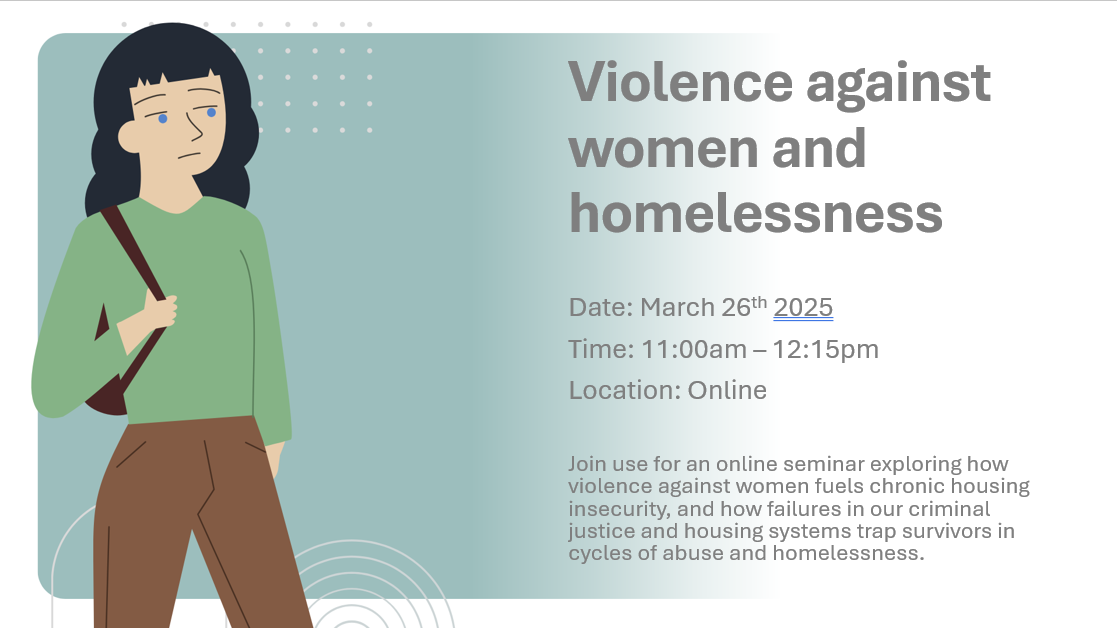
The Institute for Social Policy, Housing and Equalities Research (I-SPHERE) is hosting a seminar to present new research on the relationship between violence against women and homelessness.
Research Fellow Dr Lynne McMordie will draw on recent qualitative research in Northern Ireland that illustrates how abuse by intimate partners, family members, and strangers can lead to both acute and chronic housing insecurity.
Many women reported being forced from their homes – sometimes fleeing multiple times – even when they held legal tenancy or ownership rights. Systemic failures, including inconsistent police responses, inaccessible or weakly enforced protection orders, and exposure to further violence within homelessness services, further entrenched these cycles of violence and homelessness.
The seminar will take place online on March 26, 2025 from 11:00am-12:15 pm.
A new legal briefing sets out steps the Scottish Government and local authorities can take now to mitigate the harm caused to people in Scotland by UK immigration policy.
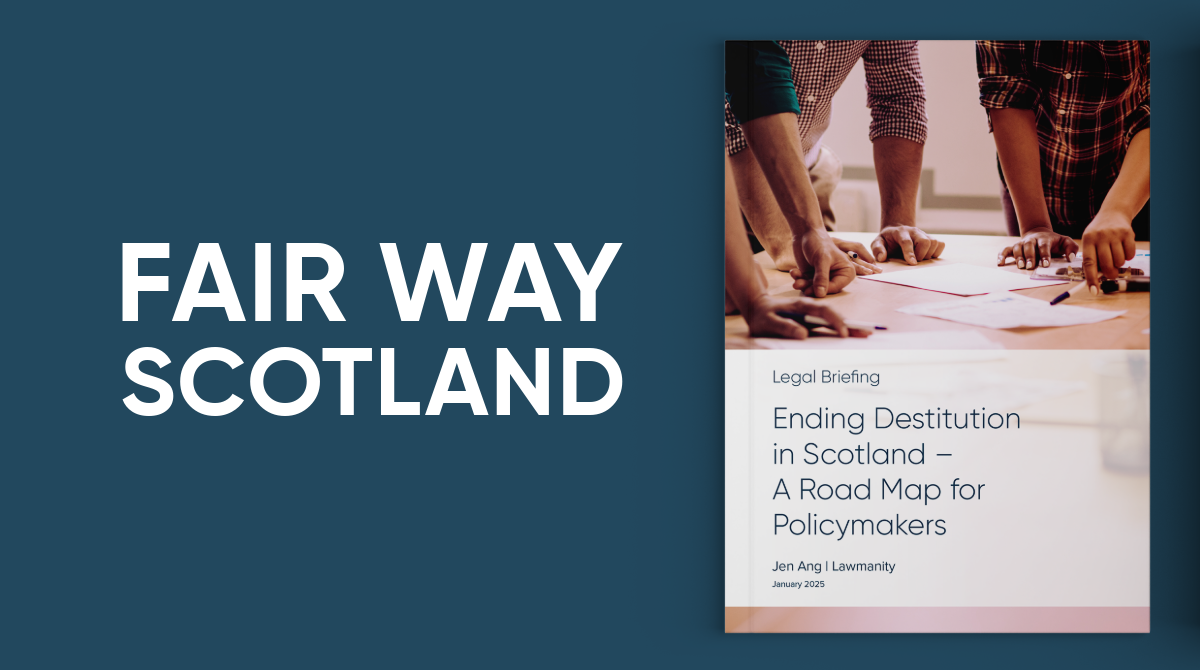
Ending Destitution in Scotland: A Road Map for Policymakers was commissioned by the Institute for Social Policy, Housing and Equalities Research (I-SPHERE) and Joseph Rowntree Foundation (JRF) through their role in Fair Way Scotland, a partnership working to prevent homelessness and destitution among people with No Recourse to Public Funds (NRPF).
The briefing by Jen Ang, for legal and strategic consultancy Lawmanity, follows the latest Fair Way Scotland evaluation report Destitution by Design, which sets out the terrible impact of the UK immigration system on people who come to Scotland to work, study, join family or seek safety.
This legal route-map argues that Scottish Government and local authorities can take positive steps to end this situation across seven areas that deliver essential support to people: social security and financial support, housing, transport, health and social care, education, work, justice and legal aid.
It challenges presumptions that reserved immigration law prevents specific groups from accessing support that would mitigate the harm they suffer at present, by presenting workable solutions that national and local government could pursue to achieve immediate positive change.
More broadly, the briefing recommends that decision makers in Scotland can fulfil their commitment to ending homelessness and destitution by reviewing and if necessary redesigning devolved policy, working with the UK Government to define ‘public funds’, improving frontline practice, and establishing parallel systems of support.
These protections have been built up over 25 years of devolution but are under threat because of the housing emergency. But this crisis is not, and never can be, an excuse or cover to water down people’s rights.
The right to a safe home is not something just for times that are easy. It is when times are tough, when councils need to decide between one priority or another, that rights come into their own.
The Cabinet Secretary has now responded to the collective and the Change Team with a letter committing to our rights.
Ms Somerville says: “They are key elements of Scotland’s strong rights for renters and homeless households and part of the protections in place to ensure homes are safe and suitable.
“I am clear that changing or suspending their application would risk regression and expose people to unsafe or unsuitable accommodation.
“As I mentioned in my previous letter, I am very proud of the rights that exist in Scotland for people experiencing homelessness and I can therefore assure you that I do not intend to pursue any changes to legislation.”
The Scottish Government today took important steps towards addressing the homelessness and housing crisis by promising to ramp up delivery of social and affordable homes with £768million of investment next year and £4million to fund homelessness prevention pilot schemes.
Homeless Network Scotland welcomes these commitments, which are crucial to set the foundation to improve things for people and communities now and in the long-term.
With more resources committed to homelessness and housing, we can continue to safeguard the strong legal rights to housing we all have – rights which are the pillars of those systems. Now is the time for councils to use the increased funds coming their way to prioritise resource to make these homelessness rights a reality again.
Money to boost homelessness prevention will help the government, local authorities, housing associations and the third sector to put meat on the bones of prevention proposals in the Housing Bill currently going through parliament.
This funding must be used to demonstrate how the Bill’s new Ask and Act duties, which will require a wider range of public bodies to share responsibility for preventing homelessness, will work in reality. The £4million should also be used to scale up successful prevention practice already taking place in parts of the country. Everyone benefits when homelessness is reduced.
Restoring investment in affordable housing is also welcome, particularly as the £768million announced includes a significant rise in capital spending on the homes we need.
We applaud the political leadership behind this action, at a time of fierce and justified competition for spending – this is the right move to benefit people and communities in the long term. Last year’s £200million cut was the wrong decision and only stored up problems for the future. There is no way to ending homelessness that doesn’t involve building sufficient social housing for people.
This time last year our sector and the people we support were dealt a severe blow in the Budget. Since then, the housing emergency has deepened and homelessness in all its forms including rough sleeping has continued to rise.
The promise of progress offered by the Scottish Government in this Budget is welcome but represents just the start of the much bigger investment in housing and homelessness that is needed to transform Scotland into a place where everyone has a home.
Members of the Scottish Parliament are voting on the Housing Bill as it comes to the end of Stage One, where the general principles of the legislation are debated and then voted on.Homeless Network Scotland is one of 23 organisations supporting this briefing produced by Crisis Scotland ahead of the debate to show why MSPs must back this legislation for the good of everyone in Scotland.
Context: Prevention measures
Part 5 of the Housing Bill contains homelessness prevention measures which will help end the housing emergency in Scotland.
The best way to end homelessness is to prevent it from happening in the first place. The measures in Part 5 of the Housing Bill will make a significant impact on the ability to prevent homelessness in Scotland, stemming the flow of people into the system and thereby reducing pressure on homelessness services. Most importantly it will preventthe trauma, indignity and stigma of homelessness for individuals affected.
Part 5 is the result of many years of work and consultation by independent expert groups and was strongly supported by respondents to the Government / COSLA consultation in 2021. It intersects with approaches to tackling poverty, reducing pressure on acute NHS services, and assistance for individuals with complex support needs.
We strongly urge all MSPs to show support for the prevention principles of the Housing (Scotland) Bill at the Stage 1 debate and show that there is cross party support for the homeless prevention measures contained within it. It is important to recognise positive work that has led us to this point.
We recognise that there are sections of Part 5 of the Bill that could be improved, and we will be working with MSPs across all parties, and with Scottish Government, at Stage 2 and beyond to do this, including gaining further clarity on the Government’s intentions for implementation.
Context: Expert development and consultation on preventing homelessness
Stable housing is one of the most fundamental of human needs. The Housing Bill contains vital measures to prevent homelessness and stabilise people’s housing situations (Part 5). These measures are the result of many years of work and consultation through a number of independent expert working groups, going back to the Homelessness and Rough Sleeping Action Group in 2017-2018, and the Homeless Prevention Review Group between 2019-2021. This group conducted detailed stakeholder engagement with over 100 organisations, and was supported by the Prevention Commission, a group of people with lived and frontline experience of homelessness, to develop the proposals for homelessness prevention duties.
Scottish Government and COSLA consulted on these proposals in 2021, and they received widespread support for the package of proposals, which were described as comprehensive, transformational and welcome. Supporters recognised the importance of early intervention and enabling a joined-up approach to prevention. Respondents believed the proposals would strengthen existing practice, improve consistency, positively impact those at greater risk of homelessness, and noted the potential long-term savings or benefits to services which could result from a focus on prevention.” (p3)
Respondents to the consultation were described as “individuals and stakeholders with detailed knowledge”, and on average 90% agreed with the questions posed in the consultation, including 87% supporting an extended homelessness prevention duty, and 93% supporting greater responsibilities on other public bodies to act to prevent homelessness.
Currently the legal homelessness framework focuses on acting when a homelessness crisis takes place. The SPICE briefing on the Bill highlights the imbalance between the statutory homelessness support and the non-statutory homelessness prevention approaches, which sometimes disincentivises an early intervention approach. Other research demonstrates how statutory homelessness services often “carry the can” for failures to intervene by other services, particularly for people experiencing severe and multiple disadvantages.
Work over the past seven years demonstrates that stronger duties on local authorities and other public bodies to prevent homelessness are needed to clarify the law, incentivise an earlier intervention approach and ensure bodies co-operate so that people don’t reach crisis point in their housing.
Moreover, the measures in the Bill echo successful legal provisions in Wales (2014) and England (2018) to prevent homelessness and develop them further by widening the scope beyond homelessness services to advance us towards a world-leading approach to joining up public services to improve people’s housing stability. Action is now being taken in Wales to go further on prevention and legislate for similar duties as outlined in Part 5 of the Housing (Scotland) Bill.
If implemented effectively, we believe these provisions will reduce the number of households who become homeless, as well as the associated costs of trauma and indignity to individuals affected. The measures will also help tackle poverty, reduce housing-related health problems, demand for acute NHS support, and reoffending rates, and they will allow for more effective holistic support for people with multiple needs and victim-survivors of domestic abuse.
Committee scrutiny of the measures in Part 5 of the Bill
The Social Justice and Social Security Committee scrutinised this part of the legislation and expressed its support for the fundamental aims of Part 5 of the Bill. The Committee highlight “broad support for the Bill’s homelessness prevention provisions amongst the witnesses the Committee took evidence from”, while also noting concerns about how these will be operationalised.
The Committee wrote “if the Bill is implemented, and it works as envisaged, this should help to alleviate some of the pressure currently being experienced in the homelessness system, including the high number of children living in temporary accommodation… the legislation could help embed… best practice” (p9)
We urge MSPs to support the Bill at this stage so that these important provisions can move forward for further scrutiny at Stage 2 of the parliamentary process.
Next steps
Should the Bill pass Stage 1, we will be working with MSPs and the Scottish Government at Stage 2 to ensure that the provisions in the Bill are as ambitious and effective as possible.
Areas we believe may need further attention at Stage 2 include:
A clearer definition of ‘threatened with homelessness’ relating to the ending of tenancies and leaving institutions (while not restricting the overall definition)
Ensure prevention support is available to people at risk of homelessness, no matter the reason (intentionality)
Ensure the Local Authority Housing Options offer is suitable for the household’s needs so that it effectively minimises future risk of homelessness
Clarify what the duty of ‘reasonable steps’ that Local Authorities must take to prevent homelessness entails, including when this duty ends – so people do not get trapped in an endless cycle of ‘help’ that isn’t working
More detail on the needs assessment process and resulting support plan produced – who is responsible for conducting this and how will the information be made available -whether a Personal Support Plan should be included in legislation.
Clarify what the Act duty on different relevant bodies entails, including co-ordination of support
Ensure there is a right to review the various stages of support, to ensure accountability and access to meaningful help.
Extend the definition of relevant bodies to include other bodies such as Social Security Scotland and explore what can be done with reserved bodies. Provide clarity and commitments on commencement timescales and implementation plans, including associated costs and expected savings.
Many of the above are in line with the areas identified by the Social Justice and Social Security Committee in their report on Part 5 of the Bill.
Alongside the passage of the Bill, we are working with Scottish Government, local authorities and other partners to begin to develop thinking on what implementation plans should consist of, especially in relation to what a ‘phase approach’ to delivery could mean. There is much good practice already happening around Scotland, as demonstrated in the 75 ways to prevent homelessness publication. We recommend existing best practice is scaled up, alongside the introduction of a Test-and-Learn Initiative to explore aspects of the proposed legislation that are unknown. Some of the findings could be embedded into regulation at a future date, including details of what Act would mean for different public bodies.
We are calling for a funding commitment in the upcoming Budget, to facilitate the scaling up of prevention best practice across Scotland, and to fund a Test and Learn Initiative for answering unknown aspects of the proposed legislation. Both programmes will help pave the way for the introduction of the legislation, but they will also make a positive impact to the national housing emergency by stemming the flow of people into the existing system.
Furthermore, we recommend the establishment of a Prevention Delivery Unit, tasked with co-ordinating work across government to successfully deliver the prevention legislation, and more broadly transition the existing homeless system to one that is designed around prevention and early action.
We use cookies to ensure that we give you the best experience on our website. If you continue to use this site we will assume that you are happy with it.
You can revoke your consent any time using the revoke consent button.