Lived experience takes a seat at top table

Services supporting people experiencing or at risk of homelessness in Scotland’s biggest city will be transformed as the new Glasgow Alliance to End Homelessness takes the lead role in co-ordinating services and prevention work. One of the most important parts of the approach to many is that its work will involve, as equal partners, people with their own lived experience of homelessness. Change Lead at Homeless Network Scotland, David Kidd, explains the process.

A few weeks before the coronavirus crisis took hold it was announced which group of organisations would lead the new Alliance, working with the city council to transform the planning, design and delivery of homelessness services. Aspire, Crossreach, Loretto Care, Mungo Foundation, Sacro, Salvation Army and YPeople make up the successful group. Objectives include ending rough sleeping, preventing homelessness and alleviating its impact, reducing the length of time people spend in temporary accommodation, minimising repeat homelessness and helping people who were formerly homeless maintain their tenancy.

Glasgow City Health & Social Care Partnership (GCHSCP) has traditionally bought a variety of homelessness services from third and independent sector service providers.  The new arrangement will see GCHSCP retain statutory responsibility for homelessness, while commissioning becomes a collaborative process alongside the service providers who formed the new Alliance and, most importantly, members of Glasgow Homelessness Involvement and Feedback Team (GHIFT).

GHIFT is made up of people with lived experience, supported by Homeless Network Scotland. Members of GHIFT have spent many months working with GCHSP, embedded in their procurement team to help decide which partnership would lead the Glasgow Alliance to End Homelessness.

This rewarding and challenging work followed on from a role helping to bring about the Alliance initially. From taking part in a co-produced, city-wide review of homelessness services, where the need for a more collaborative way of working was established, to co-designing outcomes that the Alliance will work towards – lived experience had a seat at the top table through GHIFT. Its members will continue to be involved in decision making as the Alliance ramps up. Martin, a GHIFT member who worked on the Glasgow Alliance tender, said:

“Before the scoring process started, I was worried that I wasn’t capable or didn’t know enough to fully get involved but I found that I knew more than I gave myself credit for. The training and support made the process easier and having people listen to me as an equal has made improvements to my confidence & self-esteem.”

“Because of my previous experiences I had an impression of the council as people who didn’t care about homelessness, like it was just a job. Now I’ve had the chance to see things from the other side and it has completely changed how I feel.”

Linda Hutchinson is a specialist consultant working on the Alliance procurement process and congratulated the members of GHIFT for their work, saying:

“The Glasgow experience was one of the best examples of alliance development that I have seen. The contribution made by people with lived experience from GHIFT towards reaching the final decision strengthens the process significantly, and provides additional reassurance for the HSCP that the right outcome was achieved.”

GHIFT is currently on the look out for new members.
If you, or someone you work with, has a passion for system-change and would like more information about joining GHIFT and how to get involved in ending homelessness in Glasgow, please contact David Kidd at  hello@homelessnetwork.scot or find us on Twitter @Homelessnetscot – or download the recruitment pack www.homelessnetwork.scot/ghift and find out all about it.

David Kidd (left) and GHIFT member Martin (right)

The Launch of Housing First Academy

Maggie Brünjes, Chief Executive of Homeless Network Scotland writes about the unique role that Turning Point Scotland has in the story of Housing First in Scotland and why the launch of the Housing First Academy is the right step at exactly the right time.


Homeless Network Scotland and Turning Point Scotland have a close and shared history responding to homelessness and all its related issues, and on Housing First in Scotland especially.

The late Ian Irvine is rightly credited with bringing the Housing First model to Scotland in 2010 while Operations Manager with Turning Point Scotland and long-standing trustee of Homeless Network Scotland. While a decade on, Turning Point Scotland’s Director of Operations, Patrick McKay, is serving a term as Chair of Homeless Network Scotland.

In 2016, both organisations founded Housing First Scotland alongside the Institute for Social Policy, Housing and Equalities Research at Heriot-Watt university. This team of leading academics were becoming increasingly convinced by the strength of evidence of Housing First approaches internationally and the better outcomes it could achieve in Scotland for people whose homelessness is made much harder by experiences such as trauma and addiction.

Together, we had a shared ambition to build from the Glasgow pilot and to help partners scale up the approach in their area. Housing First Scotland became a place to direct the energy and interest in Housing First among early adopters and champions emerging across all sectors. We were so inspired by the 250 delegates joining our 2017 and 2018 conferences in Stirling, before we spread out to enable 350 people to join our 2019 conference at Edinburgh’s International Conference Centre.

Of course, the landscape shifted significantly across that period thanks to the Scottish Parliament’s Local Government and Communities committee, whose year-long deliberations in 2017-18 concluded that Housing First had a key role to play in ensuring Scotland’s strong, rights-based approach to homelessness is better realised at local level. And the Scottish Government’s Programme for Government in 2017 which committed to resolving homelessness backed by a £50m fund; a cross-sector Homelessness and Rough Sleeping Action Group was appointed with Housing First, as part of a broader rapid rehousing framework, our cornerstone recommendation. 

Meanwhile, Social Bite targeted their remarkable fundraising efforts to catalyse a Housing First Pathfinder in 6 areas, appointing Homeless Network Scotland and Corra Foundation as project and fund managers, Turning Point Scotland as training providers and Heriot-Watt university as evaluators. This set in motion £6.5m primary funding from the Scottish Government’s Ending Homelessness Together Fund to increase the reach and ambition of the pathfinder.

Scotland is now on a mission to ensure that all people with the hardest experiences of homelessness across all parts of Scotland get housing first and fast. The pandemic has only asserted the urgency to have Housing First not just at the heart, but at the helm of our recovery from it.

So it’s a pleasure this week to add our warmest congratulations to Turning Point Scotland on the launch of the Housing First Academy bolstered by an online resource to train and support best delivery of Housing First on the ground. This is exactly the right step at exactly the right time in Scotland’s story of Housing First. 

The Academy and resource hub for key workers is both a beacon and a lifeline, a new community of shared ambition and shared practice. And one that can draw on experiences from within and beyond Scotland to inspire current Housing First support workers – and embrace the many hundreds more that will step up to this important role in their area over the coming months and years.

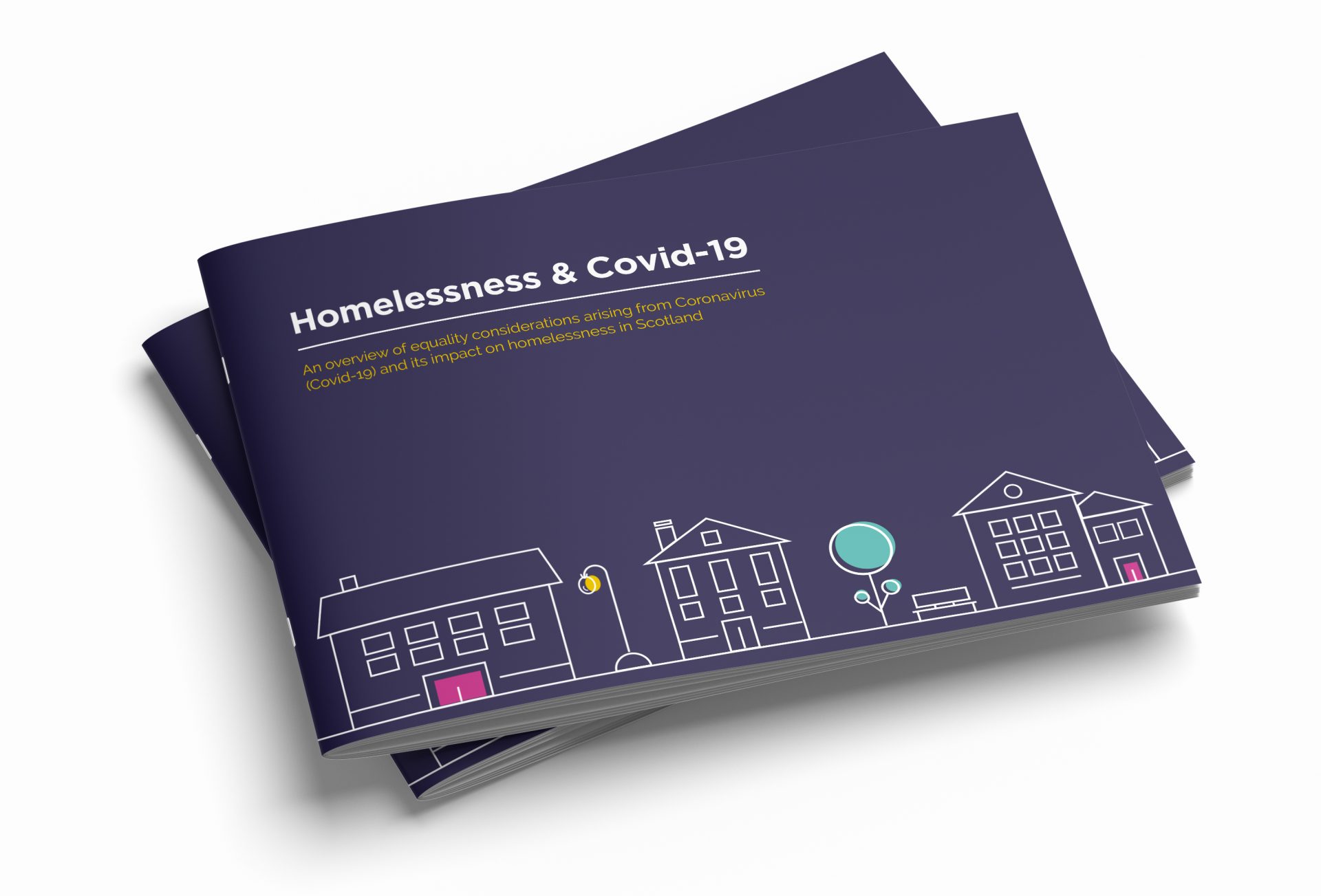
Equalities, Homelessness & Covid-19

Maggie Brunjes, Homeless Network Scotland’s Chief Executive, looks at an unfair pandemic and the reasons why we are today publishing a new framework* to help redress this across homelessness policy and services.

Already we know that the risk and impact of Covid-19 is not distributed equally. That it is having a disproportionate impact on people at the sharp end of social, income and health inequalities. And that this has a geographical pattern, which means some communities will be more affected too.

An interesting article last week from the Collaborative Centre for Housing Evidence discussed that those most damaged by austerity will also be most impacted by the Covid-19 pandemic – including young people, frontline workers and women. The Improvement Service also published an important summary of issues and potential impact of Covid-19 on those living in socio-economic disadvantage. An official inquiry has been launched by Public Health England to investigate why people from black and minority ethnic backgrounds are disproportionately affected by the virus. While this week, the Scottish Parliament’s Equalities & Human Rights Committee launched an inquiry on the impact of the pandemic on equalities and human rights.

The overarching priority for those preventing and responding to homelessness during Covid-19 is to enable everyone to be in a safe place where social distancing, self-isolation and shielding is possible. With so many remarkable response plans now in motion right across Scotland, this might be the right time to fine tune those responses – and the ones still to come – to be as sensitive to inequality as they can be.

With this knowledge, we have taken some time to consider the additional impacts of Covid-19 on homelessness in Scotland, through the lens of ‘protected’ groups – those of us more likely to be more affected by already being at a disadvantage in other ways.

If at a broader societal level we are now being encouraged in Scotland to gear up to live alongside this virus in a ‘new normal’ over the coming months, then we hope this framework can assist and signpost local authority, housing, health and third sector partners. And act as a useful guide to help direct local policy, activity and resource during the pandemic and in its aftermath.

Special thanks to a high-calibre panel of ‘expert reviewers’ who considered this framework from every angle and provided feedback to help us get it into a shape ready to share. It remains a live document, so if you spot any gaps or improvements – please do let us know.

* View the framework here: ‘Homelessness & Covid-19: An overview of equality considerations arising from Coronavirus (Covid-19) and its impact on homelessness in Scotland’ (v. 27 April 2020)

Comment: can rough sleeping in Scotland get a fresh start?

Maggie Brunjes, Homeless Network Scotland’s chief executive, asks – can rough sleeping in Scotland get a fresh start?

Just weeks before the Covid-19 crisis emerged, we held a partner’s event on the theme of rough sleeping.

There were more people in the hall that day than there were people outside with the prospect of another night with nowhere to go. A comment on the strength of commitment and shared sense of unfairness. But also the crowding of a problem which has a relatively simple solution.

In these recent weeks, hundreds of people previously sleeping rough or in unsuitable B&Bs are now being supported in hotels, short term lets and other temporary places. Mobilised rapidly, it has been the most remarkable cross-sector response during the Covid-19 crisis.

But what happens next?

It is too simplistic to say that replacing rooms with houses at the close of this pandemic will end rough sleeping in Scotland. This of course is not a single group, but a constant ebb and flow of different people moving in and out rough sleeping and temporary places, sometimes more than once, often going through the toughest times of their lives.

But it will really help. Resolving current rough sleeping and putting the brakes on the risk of it happening across the full duration of the pandemic has not just ended the risk and trauma for people affected. It has also created a window – a small amount of space for local authorities, housing and third sector partners to capitalise with new measures to prevent new episodes of rough sleeping later this year, which will have a knock-on effect next year and beyond.

And that is the break we have never caught before.

COVID-19 has forced faster progress on key fronts. It is imperative not only to protect that progress, but to ensure there is no backwards movement in local and national efforts to tackle homelessness in the aftermath of the pandemic. That needs helped, but not crowded. So we have connected with leading academics and organisations to quickly plot where we can add value together, and how we can help develop the right framework to ensure we round up and not down post Covid-19.

More on that soon.

You can view the report from ‘joining the dots’ rough sleeping event.

Freedom shouldn’t mean transition into homelessness

In 2018/19, 1,822 homeless applications were recorded as having been from people leaving prison, which represents five per cent of the total. It is likely that this figure does not represent the full scale of the problem, with applicants often unwilling to reveal their background. With discussion around more widespread early release of prisoners across the UK gathering momentum due to the pandemic, Martin Gavin – Homeless Network Scotland’s head of external relations – asks, ‘Could it be the time to break the cycle?’

Leaving prison – particularly after a lengthy sentence – is daunting in normal circumstances, and these are not normal circumstances. When a support provider described having to explain the nature, scale and significance of COVID-19 to a person leaving prison this week, it captured for me how disconnected someone can become inside, and how frightening it must be transitioning in the throes of a pandemic.

COVID-19 is causing real concern in prisons. Both prisoners and prison officers have very sadly died as a result of contracting the virus, and others feel trapped in an environment where self-isolation is near impossible. It’s understandable why early release is one of several measures mentioned in the Coronavirus (Scotland) Act. While the power to order early release is now in place, my understanding is there are no immediate plans to use that power; the caveat being, this is a fast-moving train.

Despite no concrete plan to release early, numbers up to 4000 have been circulating. I’ve been told that a more realistic estimate, should this happen at some point in the future, is 200 – 700 prisoners released, made up of people close to finishing their sentence or appropriate prisoners in one of the high-risk groups for COVID-19.

A large-scale release of people without accommodation waiting is potentially a challenge for councils and housing associations but there may be cause for a more positive take. Under the Shore Standards, government makes clear that housing services, as part of wider society, have a key role in ensuring people in the justice system and those leaving it get the support they need to make a new start and ensure better shared outcomes. Surely this is a further opportunity for landlords to show their mettle in this national emergency, as many associations have by identifying empty homes and voids for use as temporary accommodation at very short notice.

I learned this week that the first 72 hours represent the critical window for transforming a person’s chances of a successful transition. This is enough time for a bank account to be set up, people can be taken to appointments in order to avoid missing out on benefits, and arrangements put in place to discourage unhelpful contact with people or places linked to previous offending. Settled, safe accommodation sits at the heart of this process.

Second only to a roof, evidence points to the value of solid, well-resourced support services being in place straight away, able to react from the moment someone is released, being crucial to successful transition. More than 1500 prisoners leave jail each month, many from remand or short sentences, so organisations that support them are not panicking at the prospect of an additional cohort.

The good news is that strong partnerships providing this support exist already, are often long-established and where possible the process starts before someone is released.

Everything about programmes such as New Routes mentoring support for people leaving prison, managed by Wise Group and delivered by local partners, is aimed at reducing reoffending and with great success. Currently, not being able to meet prisoners routinely, New Routes providers are distributing ‘liberation packs’ that include a basic mobile phone, bus timetables and other practical items to help people negotiate the outside world, along with advice on benefits and accommodation plus telephone and email support. This can be enough to set someone on the right path.

At HMP Low Moss the prisoner support pathway starts inside jail, and is designed to offer holistic and person-centred support, from sentencing through to pre-release, on-release and after-release community support, which is co-ordinated by a Pathway Practitioner. The partnership covers all the bases, and includes Turning Point Scotland and Action for Children, among others.

In Edinburgh, Your Home is a partnership between Sacro, Four Square, Link Living, Streetwork and Y-People, that provides help to maximise income, benefits, improve budgeting skills and reduce debt as well as accessing Housing Options to secure social or other housing. The service has 35 staff and supported more than 900 people last year.

Prisoners are not routinely being released early, and the guidance suggests that other steps would be taken before this was even considered.

In the meantime, landlords could do worse than build those bridges and joint protocols talked about in the Shore Standards. Enhance existing relationships and seek out new collaboration, if not for this emergency, then for what will come after to disrupt the pattern of homelessness for people leaving prison.

Through effective joint working and information sharing, support for people making the transition from prison into proper housing could be – should be – straightforward. The community justice sector is based on strong partnerships. Associations can be confident that sector remains robust and prepared for any new developments if the services I spoke to this week are typical.

Article orginally published in Scottish Housing News on 16 April 2020.